By Julian Mills
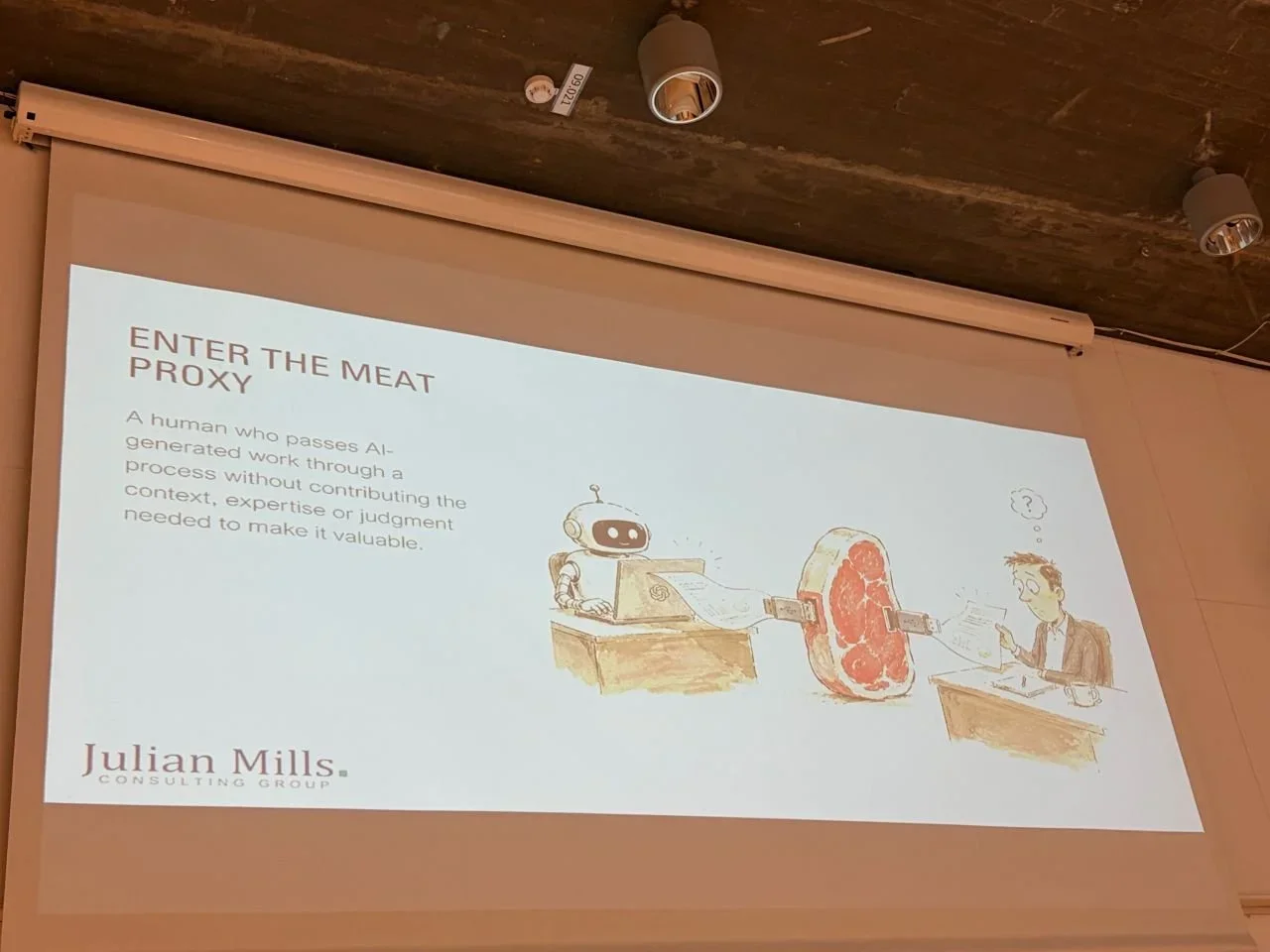
Julian Mills introducing the “meat proxy” on stage at Boye Aarhus 26
In the follow-up conversations I've been having since returning from presenting at Boye 26, two big themes have continued to resonate: agencies need to evaluate their business strategy given the disruptions being wrought by AI, and agency leaders must lean into their talent strategy.
There are two good pieces of news for those agency leaders: they have access to proven strategic frameworks, and early data suggests they are taking talent seriously.
During my MIT studies on applying AI to business strategy, we examined Michael Porter's three generic strategies for competitive advantage: cost leadership, differentiation and focus. The economic pressure agencies face is real. Gartner's 2025 CMO Spend Survey found that 39% of CMOs planned to reduce agency spending, while 22% reported that GenAI had already reduced their reliance on agencies for creativity and strategy.
Many agencies have historically competed through focus, such as specializing in B2B, B2C, particular industries or disciplines. But AI is increasingly pushing the conversation toward cost leadership, with clients questioning what agency work should be worth and, in some cases, using AI to determine budgets before engaging an agency.
This creates a strategic trap. If agencies allow clients to define their value by the cost of producing deliverables, they risk a race to the bottom.
I believe the greater opportunity lies in differentiation.
Talent is the real differentiator
Agencies have accumulated something AI cannot simply manufacture: institutional knowledge, contextual understanding, pattern recognition, creative judgment and the experience to challenge a client's assumptions. The opportunity is to use AI to amplify that expertise, rather than simply reduce the cost of producing work.
But that brings us to the second challenge: talent and leadership.
Agency economics have historically made it difficult to invest consistently in developing people. Billable hours, utilization targets and client deadlines have often taken precedence over structured training and knowledge transfer.
There's an encouraging signal. The Society of Digital Agencies' 2026 research reports that 60% of agency leaders are reevaluating their business models, while 50% plan to increase investment in employee training and development. That matters because talent development is no longer simply an overhead cost. It's becoming a strategic investment in competitive differentiation.
I've long believed that leadership is the ability to get things done through others. In an AI-enabled agency, that means developing people's judgment, transferring institutional knowledge and creating the conditions in which human expertise and AI can deliver more together. But agencies could undermine their future competitive advantage if they use AI to reduce the very opportunities through which younger professionals develop expertise.
AI may make agency production cheaper. But leadership is what can make agency expertise more valuable.