

Over the past decade, I have spent approximately $194,345 USD on themes, subscriptions, hosting, plugins, templates, and licensed media across multiple content management systems. That figure is not an exaggeration, nor is it unusual for organizations that have operated at scale in the CMS ecosystem. What makes it notable is not the amount, but the outcome: despite significant investment, much of this spend produced little durable, compounding value.
This experience is not unique. It is a structural characteristic of how traditional CMS platforms evolved. Tooling, plugins, and hosting models optimized for flexibility and extensibility, but often at the cost of long-term resilience, portability, and efficiency. Over time, complexity became normalized.
As the former owner of a hosting company, an advertising agency specializing in CMS, a board member of Open Source Matters and Joomla, CMO of Magnolia and CMO of Jahia, I believe we are at Turning Point.
I’m doing some name dropping to be dramatic and to keep your interest. Just follow me for a few more paragraphs.
In 2026, we need to step back and reconsider a basic assumption: does every website actually need a CMS?
When a CMS Is Not a Requirement
A content management system is no longer a default requirement for every website. Many brand sites have fundamentally static needs: a clear value proposition, a small number of pages, strong performance, accessibility, and infrequent updates. Modern build tools, static site generators, and hosted platforms can deliver these outcomes more reliably than a traditional CMS, while reducing security exposure and ongoing maintenance.
In these cases, a CMS often adds complexity without meaningful return. Databases, plugin ecosystems, administrative interfaces, and continuous patching introduce risk and overhead that is difficult to justify when content velocity is low and changes are handled by technical teams or agencies.
The same applies to blogs and simple content hubs. Publishing articles or announcements does not automatically require a full CMS. Lightweight workflows based on Markdown, Git, or headless pipelines can separate writing from presentation and dramatically simplify operations. In many organizations, the perceived “need” for a CMS is largely a legacy habit formed during the height of the WordPress era, rather than a reflection of current requirements.
And as we continue, yes, I read about Cursor and Sanity. That post illustrates the point coming up next.
When a CMS Still Makes Sense
None of my diatribe implies that CMS platforms are obsolete. They remain essential when content velocity, delegation, and governance matter. If non-technical users must publish frequently; if approvals, roles, audit trails, localization, and structured content are required; or if content must be reused across multiple channels such as web, mobile, kiosks, and APIs, then a CMS earns its place.
In other words, you do not need a CMS to have content. You need a CMS to manage people, process, and scale around content. Perfect for government bureaucracy and policy.
The problem is that the CMS has often been deployed far beyond those boundaries. Before I started a company, I thought, “Hey I better get Wordpress and a domain.”
Never, ever….again.
A Career Inside the CMS Ecosystem
I have spent a significant portion of my career working deeply inside CMS platforms. Joomla. WordPress. Custom plugins. Migrations. Recoveries. Performance tuning. Security hardening. The unglamorous but necessary work that keeps brand websites, blogs, and commerce platforms operating.
I still use WordPress, and I respect what it enabled. But recently, a small incident crystallized a much larger shift that has been building for years.
A Small Failure That Revealed a Larger One
I lost access to a WordPress site I wanted to recover. Database access was intact, but the application itself would not function. Despite engineering experience and familiarity with the stack, the installation was effectively unrecoverable without spending hours—possibly days—untangling version conflicts, plugin dependencies, and environment drift.
Anyone who has spent time in CMS operations recognizes this moment. Eventually, the question stops being “How do I fix this?” and becomes “Why am I fixing this at all?”
This is the quiet tax of traditional CMS platforms: recovery complexity, fragile dependencies, and systems that are harder to repair than to rebuild.
A Brief Detour: Pattern Recognition
Outside of technology, I am a long-time fan of heavy metal, particularly thrash. If you follow a genre long enough, you start to notice something interesting. Bands do not disappear; they adapt. The same ideas, energy, and intent are expressed using new production techniques and structures that fit the current moment.
The same pattern is playing out in the CMS space in a different way, some bands should just retire.
AI and the End of the Traditional CMS Workflow
There is an uncomfortable reality emerging for organizations deeply invested in traditional CMS platforms: AI is beginning to replace the CMS workflow itself, not merely assist it.
Recently, I migrated three WordPress sites using an AI-driven framework with nothing more than raw WordPress SQL exports. No themes. No plugins. No administrative UI. Media assets were reconstructed based on page content until licensed replacements were introduced.
What emerged was not a prototype or a mockup, but fully functioning systems:
Rebuilt applications with correct layout and structure
Accurate image placement and regenerated media
SEO metadata and optimization applied consistently
Landing pages with conversion and upsell tracking
Email notifications and API integrations
Cookie consent and compliance handling
Authentication, SSO, and secure client file repositories
What would traditionally take weeks or months occurred in minutes, like less than 5.
This is not about scaffolding faster.
It is about rethinking the assumption that content, layout, SEO, and workflows are fragile artifacts that must be manually preserved. Increasingly, they are becoming regeneratable outputs. Versioning is implicit, I can go back to any point at any time.
The Risk to CMS and Hosting Vendors
This shift introduces real risk for CMS vendors and hosting providers. Legacy stacks persist largely because rebuilds are expensive, risky, and slow. AI collapses that cost curve. When rebuilding becomes cheaper than maintaining, inertia disappears.
Organizations will increasingly ask:
Why are we maintaining legacy CMS stacks at all?
Why are rebuilds still scoped as if it were 2015?
Why is content treated as something to protect rather than something that can be regenerated?
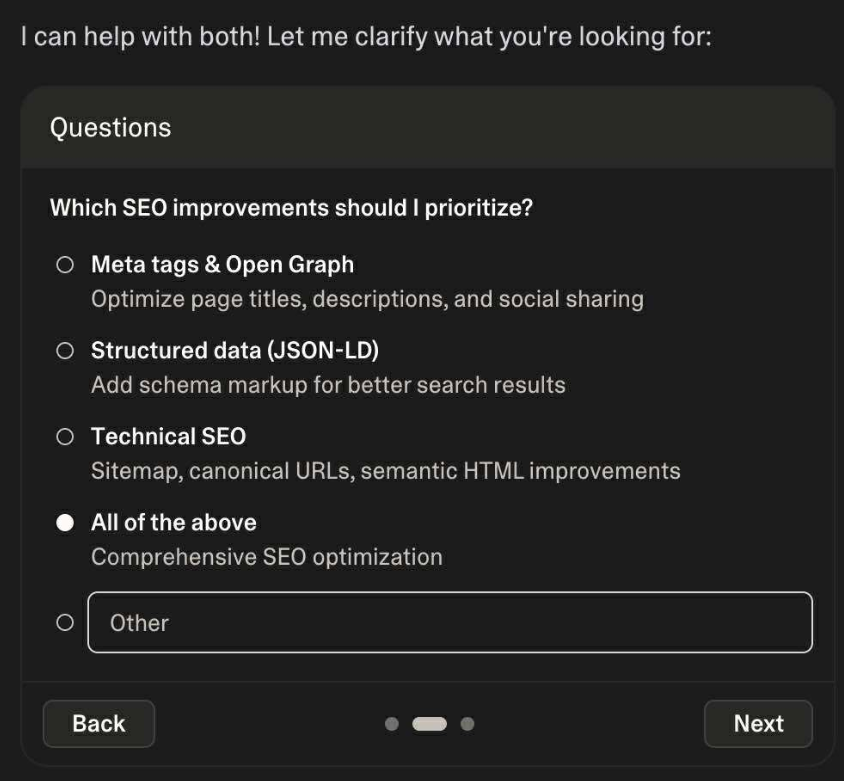
In one case, a single prompt converted a CSV into a fully functional site. In another, basic technical and Open Graph SEO was applied across an entire site and all posts in minutes. In the process, grammar issues were corrected automatically….useful, if occasionally debatable.
I even cancelled an AWS instance and two other Joomla and Wordpress premium hosting subscriptions, another $250 USD per month saving.
(FYI - I bought myself a Sauna Pod portable sauna with the savings.)
What This Means Going Forward
The CMS was a solution to a real problem. That problem has changed.
Most websites do not require the operational overhead they currently carry. A large percentage of WordPress installations exist not because they are the best solution, but because they are the familiar one. As AI-driven rebuilds become routine, that familiarity will no longer be enough to justify the cost.
CMS platforms will not disappear, just as thrash metal did not disappear. But they will evolve. Their role will narrow and sharpen, focusing on governance, scale, and multi-channel complexity rather than serving as a default foundation for every website.
We are entering a rebuild moment. Not a migration cycle, not an upgrade wave, but a fundamental re-evaluation of what is necessary, what is accidental, and what can now be regenerated on demand.
For CMS users and vendors alike, the question is no longer whether this shift is coming, but how quickly existing assumptions will be challenged by it.
The leaders in the CMS space will not be the ones we have relied on up to now.
I still love Megadeth (the band) but I don’t listen to them everyday as I once did. I don’t need them they way I did in my youth. I outgrew what I knew.