
By Janus Boye
Digital products are getting smarter and more energy intensive, and AI is accelerating that trend. Many teams are now asking how to design responsibly while still moving fast. In that context, Sustainable UX is shifting from a nice-to-have to a practical necessity.
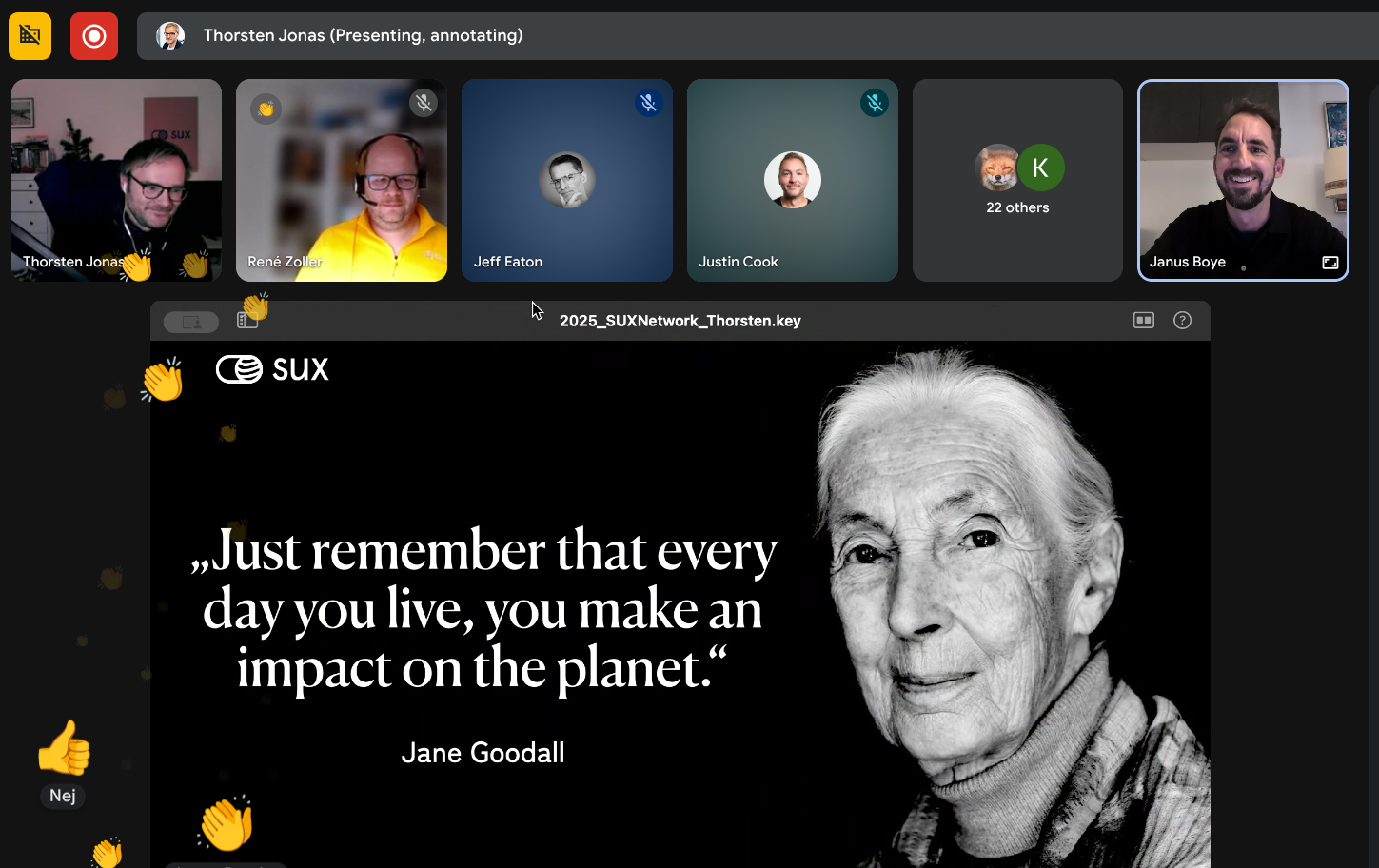
In a recent end-of-2025 members call with Thorsten Jonas, we explored the latest developments shaping the Sustainable UX Network as it moves towards 2026. Thorsten is known for using memorable quotes to anchor complex topics, and he left us with a fitting one by Jane Goodall, a long-standing environmental advocate known for her work on the relationship between humans and the natural world.
“Just remember that every day you live, you make an impact on the planet.”
As sustainability pressures grow and AI reshapes the digital landscape, the SUX network is gaining momentum around shared methods, tools, and collaborations that help organisations make sustainability a natural part of everyday design work.
As a long-time digital sustainability activist, responsible AI evangelist, and founder of the SUX Network, Thorsten combined reflection with practical direction. The session helped clarify not just why Sustainable UX matters, but how teams can start acting on it more consistently.
From “nice to have” to default
For years, sustainability in digital projects has lived in an awkward space. Widely acknowledged as important, yet rarely treated as essential. A slide in a deck. A principle in a design system. A conversation postponed until “later”, when timelines are less tight and trade-offs feel easier.
Thorsten challenged that positioning directly. Sustainability cannot remain a “nice to have” if digital products are to be taken seriously in a world facing environmental and social limits. When sustainability is optional, it is almost always outcompeted by speed, cost, or convenience.
The SUX mission addresses this head-on: making digital experiences sustainable – by default. Not as an extra requirement layered on top of existing processes, but as a foundational expectation, comparable to usability, accessibility, or security.
This shift matters because defaults shape behaviour. When sustainability is built into the way teams frame problems, evaluate success, and make trade-offs, it becomes harder to ignore and easier to act on. When it is treated as an add-on, it remains fragile and easily discarded.
Thorsten’s point was not that teams should aim for perfection, but that they should stop treating sustainability as exceptional. The real challenge for 2026 is normalisation: embedding sustainable thinking into everyday design and product decisions, even when conditions are imperfect.
Four questions for 2026
At the centre of Thorsten’s talk were four questions he believes should guide decision-making in digital teams over the next few years:
1. What is the environmental impact?
Every digital service consumes energy and resources, whether through data transfer, infrastructure, or device usage. Sustainable UX starts by making those impacts visible, even when the numbers are uncomfortable.
2. Who pays the price?
Environmental impact is rarely evenly distributed. Thorsten encouraged teams to look beyond users and customers to consider communities, workers, and ecosystems that are affected indirectly by digital products.
3. When and how do I use AI?
With the rapid rise of generative AI, this question has become unavoidable. AI can enable efficiency and creativity, but it also comes with significant environmental and ethical costs. Using it responsibly means being deliberate, not automatic.
4. Am I using things as they are, or shaping them as they should be?
This final question moves Sustainable UX from optimisation to agency. Designers and product leaders are not just consumers of technology, but shapers of it. Choosing to challenge defaults is part of the work.
Taken together, these questions form a practical ethical compass rather than a rigid framework. They are meant to be revisited repeatedly, not answered once and filed away.
Tools, not just principles
One of the strongest signals from the session was the growing maturity of the SUX ecosystem itself. Thorsten shared progress on the SUX Playbook, scheduled for release in Q1 2026, which brings together tools and templates designed to support sustainability across the full product lifecycle.
From understanding and mapping, to executing and repeating, the playbook is designed to fit into day-to-day project realities rather than sitting apart from them. Alongside this, the SUX Network now offers a large, searchable collection of resources, as well as growing work around Responsible AI, including research and a dedicated Responsible AI Canvas.
The message was pragmatic: sustainable outcomes require shared artefacts, common practices, and spaces to learn together.
A growing movement
Beyond tools and frameworks, Thorsten also highlighted the importance of community. Local SUX chapters, online events, monthly get-togethers, and the SUX Academy all play a role in keeping momentum alive and translating intent into practice.
This matters because Sustainable UX is not something organisations solve in isolation. It evolves through collective learning, challenge, and collaboration across disciplines and borders.
As we head into 2026, sustainability is becoming harder to ignore and easier to misrepresent. Regulations, AI acceleration, and mounting environmental pressure all raise the stakes for digital teams.
Thorsten’s contribution was not to offer easy answers, but to insist on better questions, clearer responsibility, and practical ways forward. Sustainable UX, in this framing, is less about perfection and more about direction.
Every digital decision leaves a trace. The question is whether we choose to see it, own it, and design accordingly.
Watch the recording and learn more about Sustainable UX
You can download the slides (PDF) or even lean back and watch the full recording from the call.
The conversation naturally continues in our peer groups and conferences. Thorsten leads both our Copenhagen design group and the Hamburg design leadership group. He is also a regular Boye conference participant.
At CMS Summit 25 back in May, Thorsten have a memorable presentation titled: The time is now for Web Sustainability (download slides) and we are fortunate to have worked closely with Thorsten since 2022.