
By Janus Boye
We began 2026 with an uncomfortable conversation about green technology and greenwashing.
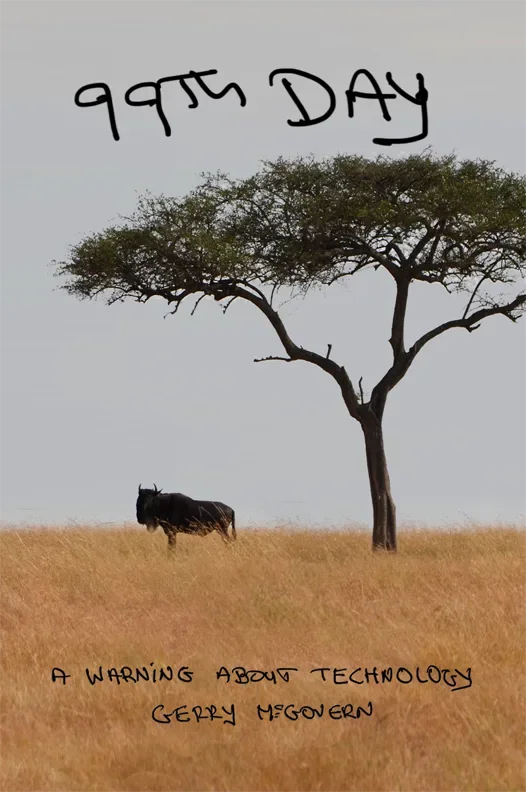
Our very first member call of the year was an unusual session with Gerry McGovern, setting a very different tone for how we might talk about technology in 2026. Framed as an informal launch of his new book, 99th Day: A Warning About Technology, the session challenged some of the most familiar narratives in digital and technology leadership.
The book is due out in early February, with its public launch taking place in Ireland on 2 February.
This was not another conversation about optimisation, AI roadmaps, or digital maturity models. It was a challenge to the stories we tell ourselves about technology and progress, and about the comforting language we use to avoid harder truths.
Early in the session, Gerry returned to two deceptively simple questions that would shape the discussion that followed:
– What do we do?
– Are there any good ancestors left to learn from?
Neither question was posed in search of quick answers. Both were invitations to slow down and examine responsibility, history, and consequence.
From digital waste to planetary damage
Gerry’s new book represents a clear shift from his earlier work. While World Wide Waste: How Digital Is Killing Our Planet – and What We Can Do About It examined the environmental impact of digital consumption and disposal, 99th Day moves further upstream, asking what happens long before devices, platforms, or data centres ever exist.
E-waste, Gerry explained, is visible and emotionally resonant, but it is not where the greatest damage occurs. The far larger impact sits in mining. By some estimates, mining waste is roughly a thousand times greater than e-waste, yet it remains largely absent from mainstream technology conversations.
“E-waste is where the story ends, not where it begins.”
As Gerry argued during the call, by the time a device is discarded, the most significant environmental damage has already been done through mining and extraction. Seen from that starting point, the idea of digital technology as clean or immaterial becomes hard to defend.
Questioning the “green transition”
A central theme of the discussion was Gerry’s rejection of the idea that we are living through an energy transition. Historically, he argued, societies have not transitioned from one energy source to another. They have accumulated energy sources.
“There has never been an energy transition, only energy addition.”
Wood did not disappear when coal arrived. Coal did not disappear when oil arrived. Renewables have not replaced fossil fuels. Each layer has simply increased total consumption.
From this perspective, many forms of so-called green technology, including AI infrastructure, data centres, and large-scale renewable projects, depend on extensive extraction of materials such as copper, lithium, cobalt, and aluminium. Declining ore quality means dramatically more waste for each tonne extracted, with the environmental burden pushed further out of sight.
This is where greenwashing takes hold. Language improves. Visuals get cleaner. The underlying material reality remains unchanged.
Wind farms, sacrifice zones, and uncomfortable truths
One of the more confronting parts of the discussion was Gerry’s critique of how renewable infrastructure is often deployed. Wind farms and other “green” projects are frequently framed as unquestionable goods, yet their physical footprint tells a more complex story.
Gerry spoke about renewable energy projects being built on indigenous land and in areas of high ecological value, turning places of cultural and environmental significance into extraction zones in the name of sustainability.
“The so-called green transition is creating green sacrifice zones.”
The point was not to single out wind power in isolation, but to highlight a broader pattern. When technologies are judged only by outputs such as megawatts or emissions targets, the costs borne by land, water, and communities are treated as acceptable collateral.
Bicycle Thinking and total cost
In response to questions from members, Gerry introduced a concept he refers to as Bicycle Thinking. It is a way of evaluating technology that resists narrow metrics such as efficiency or carbon reduction in isolation.
Instead, Bicycle Thinking asks whether a technology makes the soil, air, and water better when its total energy and material cost is taken into account. This includes mining, manufacturing, maintenance, and eventual disposal.
To make the scale more tangible, Gerry offered a striking comparison. A human body runs on roughly 100 to 300 watts. But when modern technology is included, the average person’s total energy use is closer to 11,000 watts.
“Each of us lives like we have about twelve elephants working for us.”
Against that backdrop, the bicycle stands out as a rare example of a technology that delivers genuine net benefit when assessed holistically.
What do we do, once we know?
This question surfaced repeatedly during the call, and it plays a central role in 99th Day. Importantly, it is not framed as a demand for solutions or action plans. Gerry was explicit that there is no technical fix waiting to be deployed, and no greener version of growth that will resolve the underlying problem.
In the book, the answer unfolds slowly and often indirectly. “What do we do?” becomes a question about how we decide, not what we optimise. It asks whether we are willing to slow down, to wait, to think together, and to resist the cultural pressure to act quickly simply because we can.
At one point, Gerry argues that the wisest response is often restraint: to pause, to discuss, and to accept limits. In a world shaped by technological acceleration, doing less can become a form of responsibility rather than failure.
Community, resilience, and a warning about technology
Despite the severity of the diagnosis, the session did not end in despair. Gerry repeatedly emphasised that resilience does not come from scale, platforms, or centralisation. It comes from communities.
He spoke about the importance of analogue skills and local knowledge: growing food, repairing tools, building together, sharing responsibility. Digital systems, he warned, are often among the least resilient when complex societies begin to fracture.
This brings us back to the subtitle of the book: A Warning About Technology. Not a warning that technology is evil or should be abandoned, but a warning about what happens when technology is separated from consequence, history, and material reality. Much of what Gerry challenged was not technology itself, but the stories built around it: that it is clean, immaterial, and capable of saving us from the damage it helps accelerate.
The recording of the 99th Day session is available and for further reading, Jean-Baptiste Fressoz’s More and More and More: An All-Consuming History of Energy was recommended as a valuable companion read. The book reinforces a core theme of the discussion: that modern societies have not transitioned away from energy sources so much as accumulated them, driving ever-greater material and environmental costs.
As with the conversation itself, the value lies less in agreement than in what these questions force us to confront.
What do we do, once we know? And what kind of ancestors do we choose to become?
Learn more from the intersection of digital, AI, and sustainability
Sustainability has long been a big topic in the community. Back in 2022, we last hosted Gerry for a call on his book World Wide Waste. Read more about it here: Waste is the business case of big tech
Here’s a few more recent posts, where you can explore more:
Let’s make digital smarter, safer and more sustainable (2024)
Single use food packaging. Good for the environment? (April 2025)
Sustainable UX in 2026: what’s next? (December 2025)
Be part of the conversation
If reading along is not enough, you’re very welcome to join us more actively. Our community is built around learning together, comparing notes, and exploring how theory meets practice across roles, industries and regions.
You can:
join our free, regular member conference calls
find a peer group that matches your role and challenges
attend our unique conferences, designed for deep discussion rather than surface-level inspiration
However you choose to engage, we’re glad you’re here and part of the journey.