

That statement came up in our Boye Digital Leadership peer group meeting in Hamburg this week.
I wrote it down immediately, partly because it was surprising and partly because it captured something broader. AI is moving from experimentation to operations, and organisations are starting to encounter the practical consequences.
I spent the day listening to peers share what is actually happening inside their organisations. Once again, I was reminded that some of the most useful signals about where digital organisations are heading rarely come from reports, keynotes, or vendor presentations. They emerge through conversations with people wrestling with the realities of implementation.
A few things I'm still thinking about.
AI visibility is changing, but websites still matter
AI search results still trace back to your corporate website.
One participant shared research showing that around 50% of AI-sourced citations traced back to their company's site. The "website is dead" narrative looks clearly wrong.
Much of the discussion around AI visibility assumes that traditional digital channels are becoming irrelevant. The reality appears more nuanced. The information surfaced by AI systems still has to originate somewhere, and organisational websites remain an important source.
The challenge is not replacing existing digital assets. It is understanding how information moves between those assets and the systems now using them.
The most underused B2B channel?
YouTube may be the most underused B2B channel by a significant margin.
It is evergreen, SEO-friendly, AI-friendly, and almost no one seems to be doing it consistently. That's my take, and I stand by it.
Many organisations continue investing heavily in channels where visibility becomes harder to sustain, while overlooking one where content can continue generating value for years. The opportunity has been visible for a long time. What seems to be missing is sustained commitment.
The gap between policy and practice
The enforcement paradox around AI governance came up repeatedly.
Blocking tools outright does not guarantee shadow IT disappears. On personal devices, employees can access virtually any AI service they choose. The real challenge is not zero risk; it is visible, manageable risk.
Several participants discussed approaches focused on guardrails rather than prohibitions. The objective is not to eliminate use but to make it possible to understand, govern, and improve.
As with many technology shifts, the difference between official policy and everyday practice may be where the most important organisational questions emerge.
Infrastructure becomes strategic
Design systems can no longer be viewed simply as design tools.
Sven Ditz and his team at Sitegeist recently received a Gold Award for their work using Neos CMS with DSR Hotel, a multi-brand hotel group, demonstrating how design tokens can define brand design once and deploy it consistently across multiple properties.
That is a useful reminder that design systems increasingly function as organisational infrastructure. The simple story of a design system being "a website project" no longer holds.
Digital property rights surfaced as another example. Tina Schmechel, Marketing Manager at real estate firm Pembroke, gave examples of new rights that may emerge around future digital experiences, AI-driven environments, AR, and related digital assets.
Some of the examples were mind-bending. Even if not every scenario becomes reality, the direction of travel is difficult to ignore.
The value of a simple question
For all the interesting topics, what stayed with me most was how many conversations started with a remarkably simple question:
"What's actually going on in your world right now?"
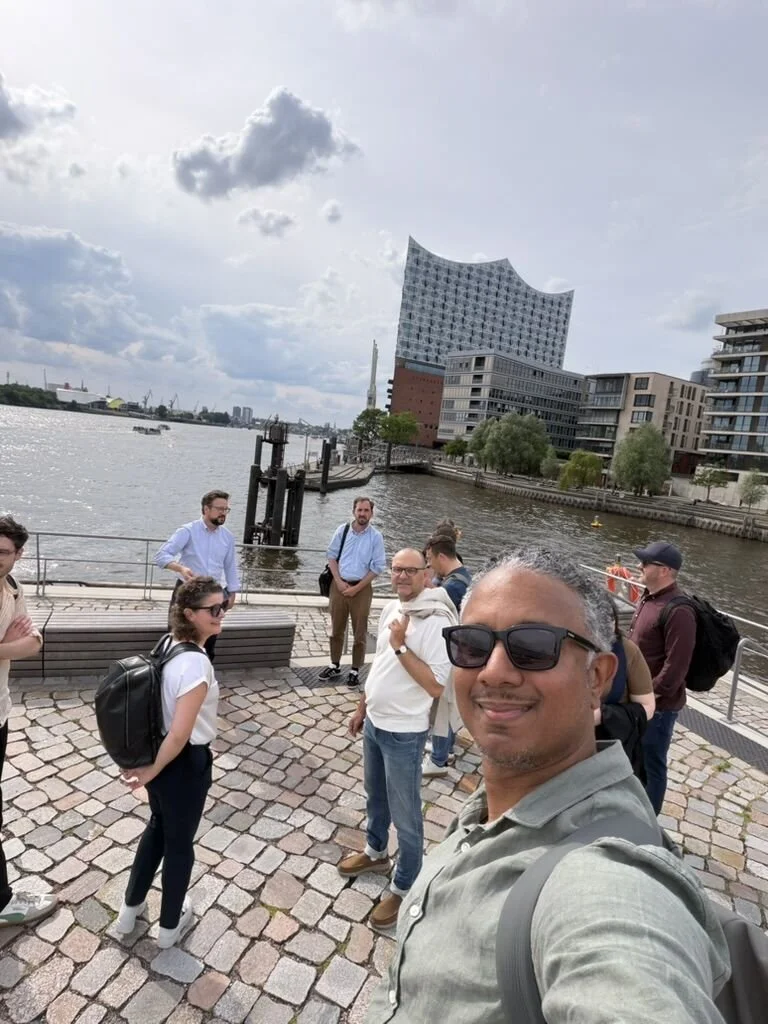
Thanks to Thomas Dugaro for showing us around HafenCity for the informal get-together in the afternoon
Despite all the knowledge available online, there is still no substitute for personal insight and lived experience. The things that matter most inside organisations are often the things that have not yet been documented, published, or presented.
Thanks to everyone who shared openly during the day, also for the informal social in HafenCity in the afternoon. These conversations are the ones that actually move thinking forward.
The examples were varied, but they pointed to a common reality. Many important changes are already underway inside organisations. The challenge is not finding information about them. It is making sure those experiences travel.