
By Janus Boye
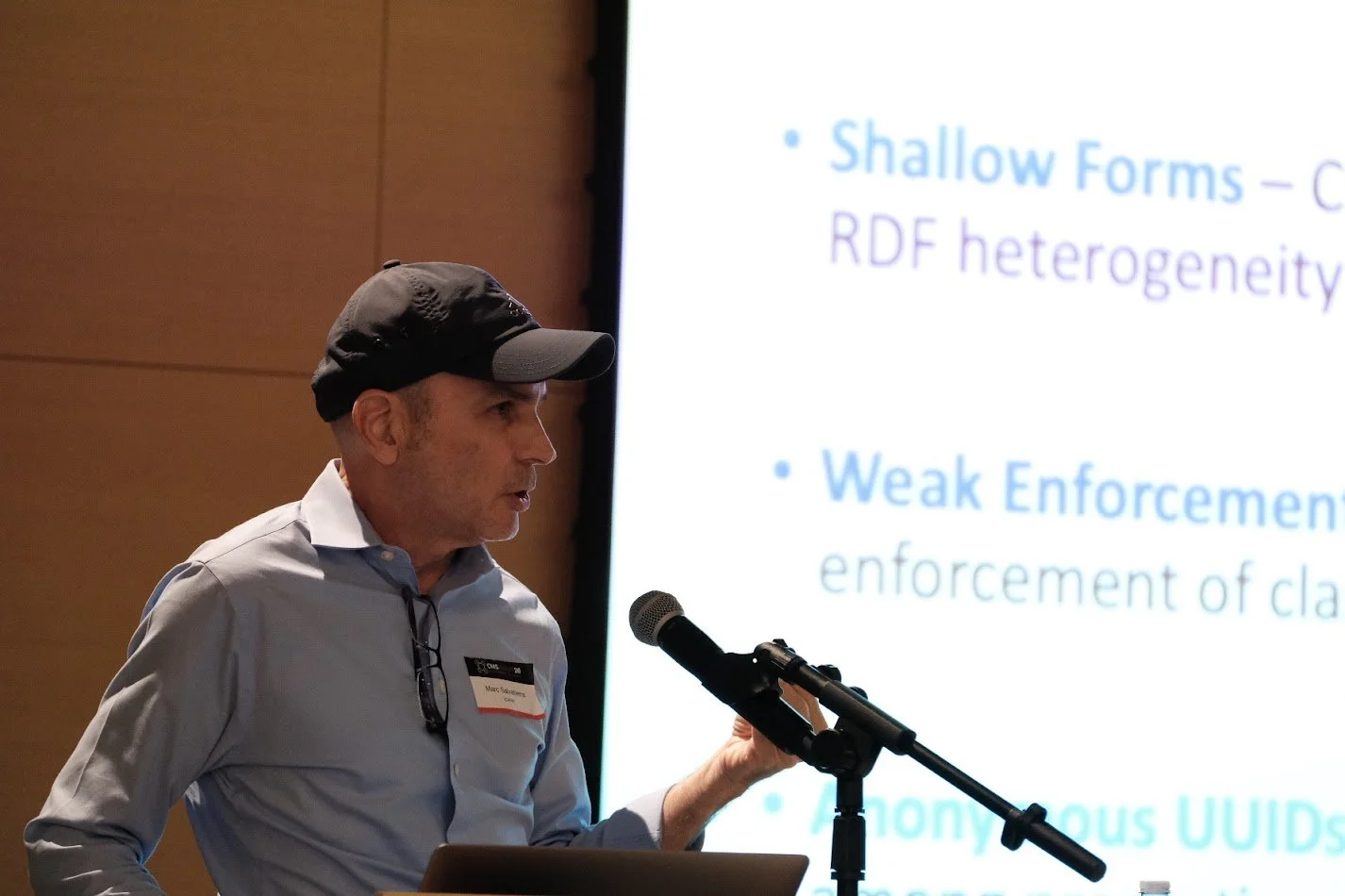
Marc Salvatierra on stage at CMS Kickoff 26, where he gave a popular presentation titled:
Beyond Schemas: How Conceptual Content Modeling Prepares You for an AI-Driven Future
What if the limits of your content are not set by AI, but by how well you understand and model it?
Artificial intelligence has become a practical concern for anyone working seriously with digital content. As organisations experiment with these tools, many discover an uncomfortable pattern: the results are impressive one moment and unreliable the next.
It is tempting to explain this inconsistency in terms of immature technology. Better AI models, better prompts, better guardrails. Yet, in conversation after conversation, a different explanation surfaces. The problem is not primarily what AI does with content, but what it is given to work with.
In a recent member call with Marc Salvatierra, Senior Product Manager for Web Content Operations at ICANN, and a long-time practitioner of content modelling, the focus was not on AI tactics but on a more fundamental question: how well organisations actually understand their own content.
The idea of knowing your content better than AI was an important part of Marc’s message. It reframes responsibility: before asking machines to interpret, connect, or reason over content, organisations need to be clear about the meaning they have already embedded, often implicitly, in their systems.
What follows reflects Marc’s perspective, shared during the call, and represents his individual views rather than an official position of his employer. The slides and recording are available in the closing chapter.
Why current content models no longer hold up
Many organisations sense that something is off with their content models, even if they struggle to articulate it precisely. Over time, these models have become tightly bound to CMSs, shaped by forms, fields, and publishing workflows rather than by meaning.
They are expected to carry more and more responsibility: pages, components, people, events, products, policies, and sometimes even organisational structures. The result is often a model that technically works, but conceptually creaks.
This strain shows up in familiar ways. Relationships between content items are shallow or implicit. Taxonomies are asked to do more than they were designed for. Meaning leaks into navigation structures, templates, and presentation rules instead of being made explicit. None of this is new, but it becomes harder to ignore when content needs to travel across channels, survive over time, and support uses its creators did not anticipate.
This is a content problem, not an AI problem
The recent wave of interest in AI has not created these issues, but it has made them visible. When AI systems struggle to produce reliable answers, or confidently hallucinate connections that do not exist, they are often reflecting the uncertainty already present in the underlying content structures.
Framing this as an AI problem is tempting, because it suggests a technological fix. In practice, it is more accurate, and more useful, to see it as a content problem. If an organisation cannot clearly explain what its content is, how pieces relate, and why they exist, it is unrealistic to expect machines to infer that understanding on their behalf.
This is the sense in which the idea of knowing your content better than AI matters. It is not about competing with machines, but about taking responsibility for meaning rather than outsourcing it to statistical models.
From “what you see is what you get” to “what you model is what you get”
For decades, digital work has been guided by the promise of immediacy: what you see is what you get, often shortened to WYSIWYG. That promise shaped tools, workflows, and expectations, and it served organisations well in a world where publishing speed and visual control were primary concerns.
Today, the more consequential principle sits elsewhere. As Marc put it during the call, coining what may yet become a useful industry shorthand: what you model is what you get (WYMIWYG).
Content models quietly determine what an organisation can say with confidence, what it can reuse, and what it can safely automate. Most teams spend their time at the logical level of modelling: content types, fields, validation rules. These are necessary, but they are not sufficient when content needs to be understood rather than merely rendered.
This is where a brief look back helps. The original ambition of the Semantic Web was not a web of prettier pages, but a web of meaning. That ambition faded from view for many years, partly because the effort required to model meaning explicitly seemed to outweigh the benefits. AI has changed that balance. Machines now participate directly in interpretation, retrieval, and synthesis. When meaning is not modelled explicitly, it does not disappear; it is guessed.
What is changing in the next generation of CMS platforms
"... the next generation of CMS platforms will be built on RDF graphs, property graphs, or, ideally, a hybrid of both, not on relational models. The result will be native, intelligent, graph-native structured content that is continuously refreshable, inherently connected, and ready to be mined by AI systems."
— Michael Iantosca, Principal Architect at Avalara
Marc wove this quote into the conversation to illustrate that the shift he was describing is not speculative. Michael Iantosca is a long-standing industry practitioner in content strategy, structured authoring, and knowledge engineering, and his observation reflects patterns already visible in many large-scale content environments.
RDF, or Resource Description Framework, is one of the foundational standards behind this shift. Rather than inferring meaning from structure, RDF makes relationships and semantics explicit, allowing content to be connected, reasoned over, and reused across systems.
Seen in that light, Iantosca’s comment reads less like a prediction and more like a description of where many organisations are already heading. Relational, field-based CMS architectures continue to work well for storage and editing, but they struggle to express richer relationships, shared concepts, and meaning across organisational boundaries.
The emerging shift is therefore not about abandoning CMS platforms, but about repositioning them. The CMS becomes one participant in a wider semantic landscape, alongside organisational models, domain models, and external data sources. Graph-based approaches, whether through RDF, property graphs, or hybrids, offer a way to treat content as connected knowledge rather than isolated records.
What changes most is not the tooling, but the centre of gravity. Content models are no longer defined primarily by what fits into forms or databases, but by how meaning is represented and shared over time, independent of any single system or channel.
What conceptual content modelling makes possible
A concrete illustration of this approach came up during the member call in the form of the RTVE Play Ontology. Developed by Radiotelevisión Española, it shows how a public broadcaster has made its content, people, productions, and organisational context explicit in a shared semantic model, rather than scattering that meaning across CMS fields, taxonomies, and presentation logic.
It is worth separating this from current discussions around generative engine optimisation. GEO focuses primarily on page-level semantics, helping external AI systems discover and surface content more effectively. Conceptual content modelling operates at a different level. Its concern is not just whether content can be found, but whether its meaning is explicit, consistent, and usable across organisational and machine contexts.
In practice, the two approaches work best together. GEO benefits from clearer underlying meaning, while conceptual models gain reach when their outputs are exposed at the page level.
Conceptual content modelling focuses on meaning first. It separates the question of what something is from how or where it is published. When concepts, relationships, and constraints are made explicit, several things become possible.
Internally, content becomes easier to reason about. AI systems can retrieve information with greater confidence, because they are guided by declared relationships rather than inferred proximity. Externally, page-level semantics and optimisation still matter, but they sit on top of a more stable foundation.
Perhaps most importantly, conceptual models allow organisations to see their content as a coherent whole. Content, people, activities, and decisions can be described in the same semantic space, rather than being stitched together after the fact.
Making progress without starting with theory
One of the most common questions is how to move in this direction without turning it into an abstract or academic exercise. Experience suggests that starting with theory is rarely effective.
A more productive starting point is people. Conceptual content modelling benefits from engagement beyond the immediate CMS or web team. That often means reaching out to the semantic and knowledge graph community, working with a knowledge engineer or ontologist as a subject-matter expert, and partnering closely with technically minded developers or data scientists who are comfortable reasoning about structure and relationships.
Choosing the right tools matters, but not in the sense of committing to a platform too early. Many practitioners begin with what Marc described as “mental code”: developing shared conceptual clarity using RDF as a way of thinking rather than as an immediate implementation target. Lightweight tools such as gra.fo or Protégé can support construction and visualisation, while avoiding reliance on spreadsheets that tend to flatten relationships rather than reveal them. Early models can live quite happily as flat RDF files, whether in RDF/XML or JSON-LD.
Just as importantly, conceptual models grow best when they follow the organisation, not the other way around. Starting with a small number of meaningful subdomains allows teams to focus on stories that matter, rather than abstract completeness. Modelling essential scenarios with real demand, an idea long emphasised by Daniel Jackson, helps ensure the model stays grounded. Useful raw material can often be found in existing organisational artefacts such as mission statements, bylaws, annual reports, financial structures, organisational charts, or ticketing systems.
In practice, momentum comes from working on a small, meaningful slice of content where clarity already matters. By modelling that area carefully and showing what becomes easier or more reliable, teams create shared understanding through results rather than persuasion.
This approach treats change as a familiar product pattern: start small, demonstrate value, and expand from there.
The conversation continues
Understanding your content well enough to model it conceptually is not a one-off exercise. It is an ongoing practice that sits at the intersection of content strategy, information architecture, technology, and organisational learning. It benefits from comparison, reflection, and seeing how similar questions play out in different contexts.
If reading and being part of an online call is not enough, you’re very welcome to engage more actively. The community around these conversations is built on learning together, comparing notes, and exploring how theory meets practice across roles, industries, and regions.
You can:
download the slides (PDF) or even lean back and enjoy the entire recording
join our free, regular member conference calls
find a peer group that matches your role and challenges
attend our unique conferences, designed for deep discussion rather than surface-level inspiration
However you choose to engage, we’re glad you’re here and part of the journey.