
By Janus Boye

Rafaela Ellensburg is a Dutch content engineer
Content engineering is entering a new phase. In 2026, it is no longer only about structure and reuse, but about designing content so it can work effectively with AI, systems, and people across increasingly complex environments.
Many organisations are already feeling this shift, even if they are not naming it. Content is being queried, recombined, and evaluated by systems that sit outside traditional publishing workflows. AI applications depend on it for reliable output, while personalisation and multi-channel delivery stretch it across contexts it was never explicitly designed for.
The difficulty is that most content models, workflows, and governance structures have not kept pace. They were built for managing pages, not for supporting content as data moving through operational systems. What once worked as a stable foundation is now showing its limits under new demands.
This creates a growing mismatch between how content is structured and how it is actually used. This gap framed a recent member call with Rafaela Ellensburg, where the focus was on what changes when content engineering is treated not as an additional discipline, but as a shift in how content is defined, connected, and maintained in practice.
Rafaela Ellensburg is owner of The Content Engineering Agency. She works at the intersection of content, data, and technology, advising organisations on how to make content usable across systems rather than tied to individual channels.
The conversation started with the shifts Rafaela is seeing in practice.
What is changing in Content Engineering
A clear shift is underway in how content models are designed. Where they once primarily supported publishing and reuse, they are now expected to support AI retrieval and action. Content is no longer just assembled for pages. It is queried, interpreted, and recombined across systems that teams do not fully control.
This changes the role of structure. It is no longer sufficient to define components and relationships within a CMS. Structure now extends into what can be understood as context architecture: metadata, relationships, and connections that allow systems to interpret meaning reliably at scale.
Another way to describe this shift is moving from content as components to content as an operational system. The model still matters, but only as part of a broader system that includes workflows, governance, and measurement. Content is increasingly treated as data moving through processes rather than assets sitting in repositories.
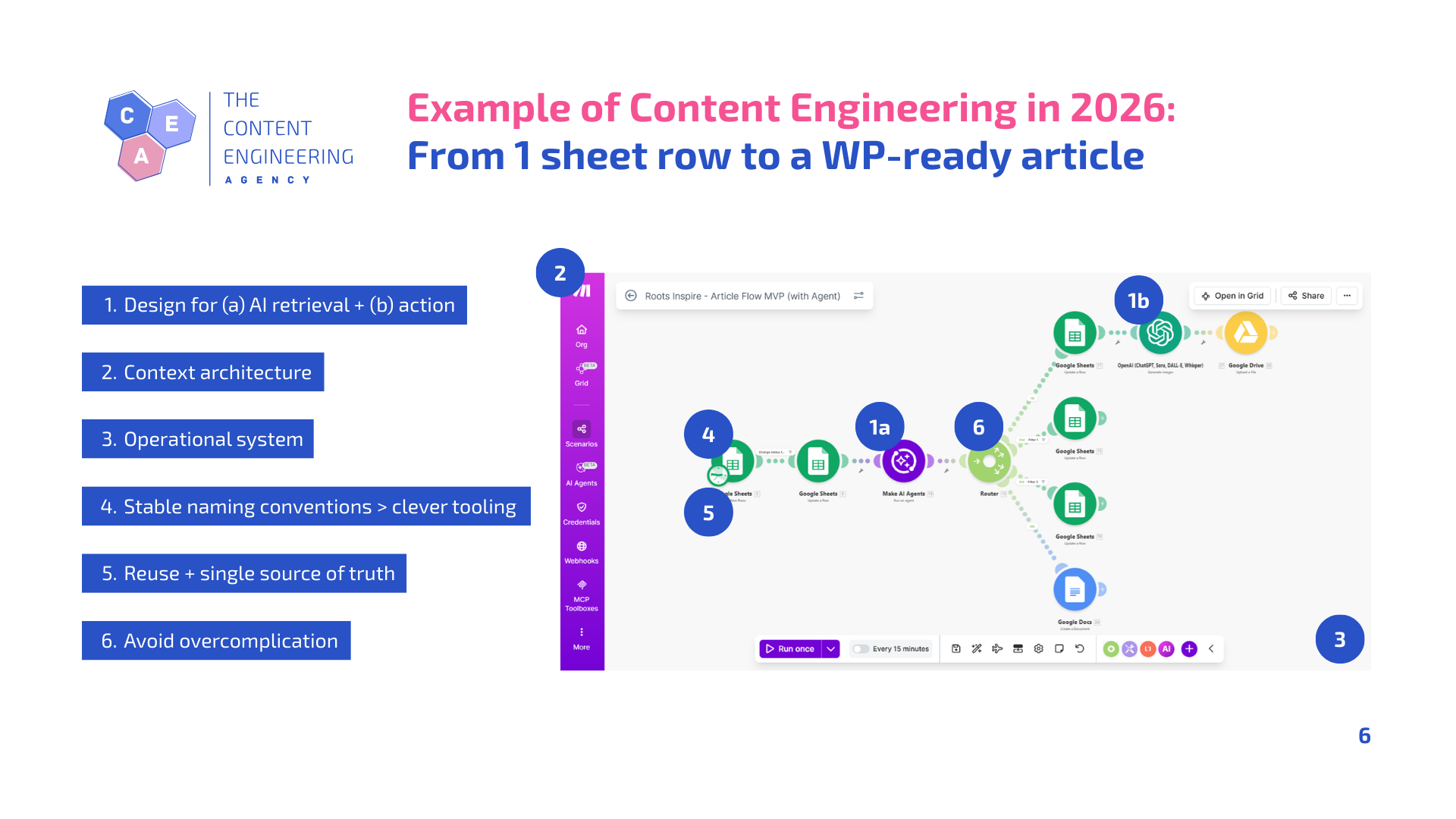
An specific example of content engineering in practice in 2026 as shared by Rafaela
From models to operations
One of the more concrete examples discussed was how a content model can be operationalised through workflows. Rather than stopping at schema design, the model becomes part of a system where structured inputs trigger downstream processes.
In one example, a single row of structured data, enriched with metadata, could initiate a workflow that generates and routes content outputs across channels. Context such as tone of voice, brand guidelines, and SEO signals provided grounding, while an AI agent handled generation and assembly.
The point was not the tooling itself, but the connection between model, context, and workflow. A content model only becomes valuable when it operates within a system. Without that connection, even well-designed models remain theoretical.
This is where many teams currently struggle. Significant effort is invested in modelling, while far less attention is given to how those models behave once they are put into use. The gap between design and operation is where complexity begins to accumulate.
Where teams struggle
A recurring pattern is to respond to new demands by adding more layers: more fields, more rules, more tooling. In practice, this often leads to systems that are difficult to maintain and even harder for teams to work within.
Several risks stood out in the discussion. One is adopting AI capabilities on top of poorly governed or inconsistent content. When content is treated as data, quality issues scale quickly, leading to unreliable outputs rather than increased efficiency.
Another is over-atomising content before understanding which patterns actually drive value. Breaking content into ever smaller pieces does not automatically make it more usable. It can just as easily make it harder to manage.
There is also a tendency to design large, comprehensive models intended to cover every scenario. In practice, these often prove difficult to evolve. Teams either work around them or abandon parts of them over time.
Organisational implications
Content engineering rarely has a clear home within organisations. It spans content, UX, engineering, and product, yet is often owned by none of them. This leads to fragmented decisions about models, workflows, and tooling.
The discussion highlighted the need for stronger alignment across roles. In some cases, this requires a degree of top-down direction to establish shared standards and ways of working. Without that, decentralised teams tend to optimise locally, resulting in duplication and inconsistency.
Centralisation alone, however, is not sufficient. Content engineering needs to reflect how teams actually work. It is as much a coordination practice as a technical one, requiring shared understanding and ongoing negotiation between disciplines.
This is where peer group conversations become particularly useful. Hearing how others are structuring their work, where they are encountering friction, and how they are resolving trade-offs helps ground decisions in practice.
What seems to matter now
Stepping back, a few patterns stand out. Treating content as linked data provides a more stable foundation for AI-driven use cases than loosely structured content. Thinking of content as products in a supply chain shifts attention towards flow, dependencies, and efficiency.
Many fundamentals remain unchanged. Stable models, clear naming conventions, and strong governance continue to matter more than sophisticated tooling. Reuse and consistency are still the basis for scale.
A consistent theme was the importance of starting small. Rather than attempting to redesign everything at once, teams can focus on specific use cases, demonstrate value, and gradually connect models and workflows across domains.
Content engineering in 2026 does not yet feel like a settled discipline. It is better understood as a shared problem space, where many organisations are working through similar challenges and learning from each other as they go.
The conversation continues
If reading and being a part of an online call is not enough, you’re very welcome to join us more actively. Our community is built around learning together, comparing notes, and exploring how theory meets practice across roles, industries and regions.
Rafaela has shared her experiences with us for a while, both in our Benelux community and also in a previous members call. Read more:
You can also:
download the slides or even lean back and enjoy the recording from the call
join our free, regular member conference calls
find a peer group that matches your role and challenges
attend our unique conferences, designed for deep discussion rather than surface-level inspiration
However you choose to engage, we’re glad you’re here and part of the journey.