
By Janus Boye

Jasmin Guthmann is VP Composable Consulting at Accenture Song and Board Member at MACH Alliance
Most leadership failures are not failures of strategy. They are failures of behaviour under pressure.
Plans are usually sound enough. Priorities are broadly aligned. Yet something shifts in execution. Conversations become reactive, decisions escalate too quickly, and patterns repeat despite everyone recognising them. What breaks down is not knowledge, but the ability to respond well when it matters most.
This is particularly visible in transformation-heavy environments. The work is complex, the pace is high, and expectations are rarely reduced. In those moments, emotional patterns are not a side issue. They are often the deciding factor.
The difficulty is that these patterns are rarely named directly. They sit just below the surface of delivery work, shaping outcomes without being treated as part of the system itself.
In a recent member call with Jasmin Guthmann, this gap was addressed head-on. Rather than treating emotional intelligence as a personal trait, the discussion positioned it as a practical discipline for navigating exactly these moments.
Jasmin Guthmann is a leadership author, growth strategist, and community chair at MACH Alliance. She works with leaders operating in high-pressure, high-expectation environments, with a focus on what actually changes behaviour in practice.
The conversation started by grounding this in a simple but important question: where does leadership actually show up when the pressure is real?
Leadership shows up under pressure
True leadership rarely reveals itself when conditions are stable or predictable. It becomes visible when people are tired, under pressure, and still expected to perform.
Most organisational models assume a level of stability that rarely exists. In practice, leaders operate in environments shaped by competing priorities, incomplete information, and constant change. In these conditions, emotional responses start to shape outcomes in decisive ways.
There is also a structural dynamic at play. As leaders become more senior, they tend to receive less direct feedback, while their behaviour has greater impact. Patterns go unchallenged, even as they scale across teams.
Seen this way, emotional intelligence becomes less about personal awareness and more about how leadership actually functions in the organisation.
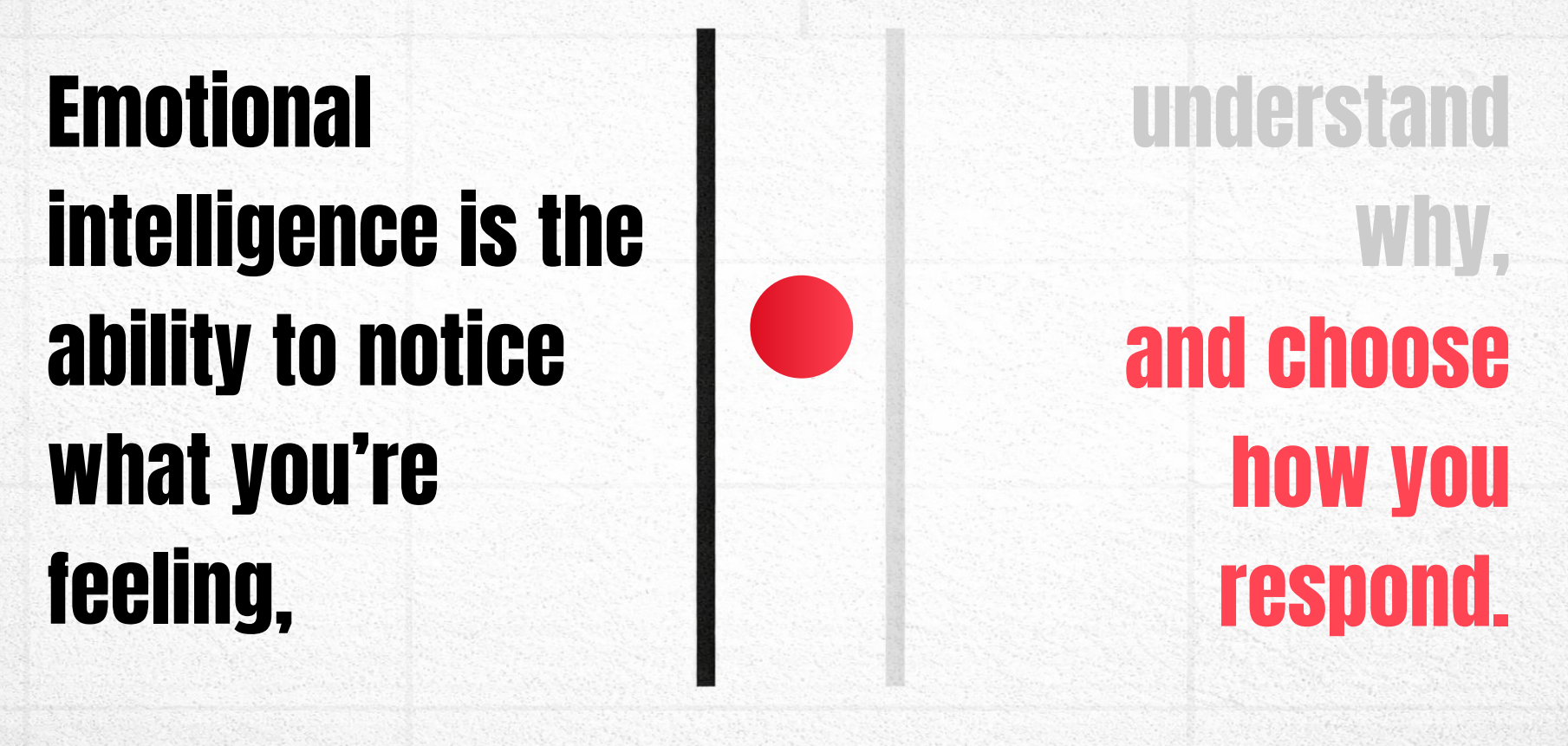
The definition of emotional intelligence according to Jasmin Guthmann
Emotional intelligence as a performance multiplier
A central idea from the session was the framing of emotional intelligence as a “performance multiplier.”
This is a useful shift. It positions emotional intelligence not as an additional layer on top of leadership, but as something that directly affects execution. The question is not whether leaders are empathetic or agreeable, but whether they make better decisions when pressure is high.
Emotional intelligence is not about being nice. It is about making better decisions when pressure is high.
In organisational terms, this connects to familiar issues. Reactive decision-making, unnecessary escalation, and inconsistent leadership behaviour are rarely caused by a lack of expertise. They are often the result of unexamined emotional responses playing out in real time.
Where emotional intelligence is strong, the effects are practical. Communication under stress improves. Decisions become less reactive. Leadership behaviour becomes more consistent. The outcome is better execution without additional effort.
The gap between reaction and response
The framework presented in the session was deliberately simple:
Notice what you are feeling
Understand why you are feeling it
Choose how to respond
Its value lies in creating a small but critical gap between reaction and response.
In many organisations, that gap collapses under pressure. The default is speed. Decisions are made quickly, responses are immediate, and reflection is deferred. This works until it does not.
That gap is where leadership judgement sits. It is where a conversation can either escalate or move forward constructively. It is where a moment of frustration can either reinforce an existing pattern or interrupt it.
The difficulty is not understanding the model. It is maintaining that gap when conditions make it hardest to do so.
Patterns shape outcomes
A practical exercise in the session focused on identifying trigger patterns rather than isolated incidents. Participants were given three minutes to map a recurring situation step by step: what triggers it, what emotion appears first, what story they tell themselves, and what behaviour follows.
This focus on patterns is important. Individual moments are easy to dismiss as exceptions. Repeated patterns point to something structural.
In organisations, these patterns often sit below formal processes. A recurring frustration in meetings, a tendency to avoid certain conversations, or a habit of escalating issues too quickly becomes part of how work gets done.
One example shared in the discussion involved frustration with team members not completing agreed actions. The initial reaction was directed at the team. The underlying issue turned out to be a lack of clarity in communication.
This kind of shift is small, but it changes where responsibility sits. It also changes what can be improved.
The wall as a familiar moment
The ultramarathon example used in the session offered a useful analogy. There is a point in the race where familiar patterns stop working and self-doubt emerges. The decision at that moment is whether to stop or to continue.
Organisational work has similar moments. Points where previous experience no longer provides clear guidance, and where the next step is uncertain.
What emotional intelligence offers in these situations is not certainty, but the ability to stay with the discomfort long enough to make a considered decision.
From awareness to organisational practice
The final part of the discussion moved from awareness to application. Mapping emotional triggers, interrupting unhelpful patterns, and applying these insights in real situations are all necessary steps.
The challenge is that this is not purely an individual capability. It is shaped by the environment leaders operate in. Time pressure, cultural norms, and organisational structures all influence whether reflection is possible.
This is where peer groups become relevant. These patterns are rarely unique to one organisation. They are shared across teams and contexts. Making them visible, and discussing them openly, creates the conditions for change.
Emotional intelligence, approached in this way, becomes less about individual improvement and more about how organisations learn to operate under pressure.
A shared challenge
Emotional intelligence is often treated as something optional or secondary. In practice, it sits at the centre of how decisions are made and how work moves forward.
The challenge is not recognising its importance. It is building the discipline to apply it when it matters most.
That remains a shared problem across organisations, and one that benefits from being examined together.
The conversation continues
If reading and being a part of an online call is not enough, you’re very welcome to join us more actively. Our community is built around learning together, comparing notes, and exploring how theory meets practice across roles, industries and regions.
You can also:
download the slides or even lean back and enjoy the entire recording
join our free, regular member conference calls
find a peer group that matches your role and challenges
attend our unique conferences, designed for deep discussion rather than surface-level inspiration
However you choose to engage, we’re glad you’re here and part of the journey.