
By Janus Boye
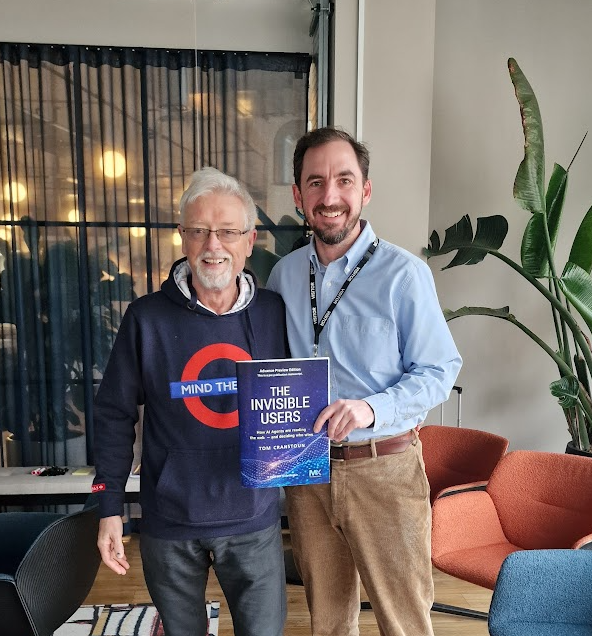
Tom Cranstoun to the lift with Janus Boye holding an advance copy of the new book: The Invisible Users
A new type of user is emerging, and most organisations are not yet set up to recognise them.
AI agents that search, evaluate, and make decisions on behalf of others are beginning to shape how people interact with digital services. This is not a distant trend. It is already visible in shifting traffic patterns and in how decisions move away from the journeys many of us have spent years refining.
I was reminded of this when I received an advance copy of The Invisible Users by Tom Cranstoun. The book explores how AI agents use the web to make decisions, and what that means for how we design and operate digital experiences.
It is a useful lens. It also makes something else harder to ignore.
The users we have always overlooked
The idea of invisible users is not new.
For a long time, it has referred to people we tend to design for less: people with visual impairments, people with limited mobility, and people who simply do not fit the assumptions built into most digital services.
They have always been there. The difference has been whether organisations chose to prioritise them.
In practice, accessibility has often been treated as a constraint rather than a design principle. Something to address late, or only when required. That decision has shaped what gets built, and who it works for.
AI agents now bring a different kind of pressure. They make invisibility less abstract.
When invisible users shape outcomes
AI agents are not passive consumers of content. They interpret, filter, and act.
They influence traffic. They affect conversion. They shape how services are discovered and evaluated.
That changes the nature of the problem. Invisible users are no longer only a question of inclusion. They are also a question of performance.
This creates a more immediate tension for organisations. It is no longer sufficient to assume that designing for a default user will carry the system. The system itself is changing.
Where organisations are not yet aligned
The organisational implications are easy to underestimate.
Responsibility for accessibility, content structure, and discoverability is often fragmented. UX teams focus on interfaces. Content teams focus on messaging. Data and SEO teams focus on traffic and performance. Increasingly, AI-related work sits elsewhere again.
Each area evolves in parallel. The connection between them is less clear.
Designing for agent-mediated interactions does not sit neatly in any one of these domains. It requires coordination across them. It also requires clearer ownership than many organisations currently have.
Without that, responses tend to be reactive. Teams optimise locally while the system drifts.
A shift in expectations
AI introduces new capabilities, but as I have said in the past: AI also raises expectations.
Technically, services need to be more structured, more interpretable, and more consistent. Socially, there is increasing scrutiny around who digital services actually serve, and who they exclude.
These pressures reinforce each other. Designing for AI agents may improve clarity and structure. It does not automatically improve accessibility for people.
That distinction matters. It highlights the need to be explicit about which users are being prioritised, and why.
A shared point of tension
The Invisible Users is a timely contribution because it connects two things that are often treated separately.
AI agents acting on behalf of users, and people whose needs have always been less visible.
Both challenge how organisations define users. Both expose where responsibility is unclear or fragmented.
The question is not only how to respond to AI as a new actor on the web. It is whether this moment leads to more deliberate choices about who we design for, and how consistently we follow through.
That remains a shared challenge across teams and organisations.