
By Jeroen Fürst

Jeroen Fürst. Kentico MVP - Architect
Do we still need websites in the age of AI? That was one of the more provocative questions raised during the latest Benelux Digital Leaders Peer Group, organised by Boye & Co and hosted at Crossphase Presenter in Leiden on 27 August 2026. It was also only one of many.
Around the table were digital leaders, agency owners, content specialists, platform experts and people responsible for some complex digital environments. The afternoon moved from a mid-year reality check on AI and the CMS market to changing content roles, the state of content modelling, and the practical challenge of deciding what comes after a fragmented CMS landscape. Tridion came up often enough during the introductions to trigger a few shared memories, and judging by Janus Boye’s reaction, possibly a few flashbacks too.
Content was the thread running through almost every conversation. How we create it, structure it, govern it, migrate it, expose it to AI, and how we organise the people responsible for it. The technology is moving quickly, while a lot of the hardest questions turned out to be familiar.
The question in the title belongs to that pattern. It came up early and kept getting sharper as the sessions circled the same subject from different directions.
2026 half-time show
The afternoon opened with a mid-year pulse check. The tone stayed open and practical, with no glossy future slides, and the conversation ranged much wider than I can cover here. A few themes kept coming back.
AI has moved into the daily work
Nobody spent time on whether to use AI. The discussion had moved on to where it genuinely adds value, where it is still unreliable, and what happens once it starts shaping roles, workflows and decisions rather than only output. One participant described how much AI has already changed research work, and how human judgement seems to matter more as the tools get embedded deeper.
Synthetic users and AI personas came up as something several people had experimented with: test a message or a journey against a few thousand simulated profiles. Bias, false confidence and over-simplification were all named. Nobody was ready to call it settled.
Agents got similar treatment. For some people an agent is a reusable prompt wrapper, for others an autonomous system that calls tools and works through multi-step processes. One suggestion made the discussion clearer: call most of them automations and look at what is left. That question stayed open as well.
Agency and vendor models are shifting
Delivery and pricing models are under pressure, clients want more help navigating complexity, and several people described agencies moving towards software vendor territory by productising a specific expertise rather than building broad platforms. The line between services and software keeps blurring. On the vendor side, CMS and DXP (digital experience platform) propositions keep converging on the same middle ground, which to several people read as another turn of a familiar industry cycle. Vendors are also reconsidering how they plan and prioritise in a market moving this quickly, and Kentico came up as one example of that shift towards greater adaptability.
For me, the most interesting item on that list was AEO and GEO, meaning visibility inside AI-generated answers. If AI assistants answer more questions on behalf of users, some visits to a website stop happening. Those answers still have to come from somewhere, which makes well-managed and authoritative sources more valuable instead of less. One comparison from the discussion put it well: SEO often feels like a winning game, while AEO can feel more like a losing one, because being absent from the answer is suddenly very visible. Both halves came back in the final session.
Content people are still not in the room
The most relatable stretch of the afternoon. Content is critical to every organisation represented, and the people closest to it are regularly absent when the systems around it get chosen. That opened up several other discussions around the table, including what we even mean by content now and why it is still treated as a commodity in so many places. Tools only start working when the people using them are part of the decision.
The cost of AI, on the invoice and beyond
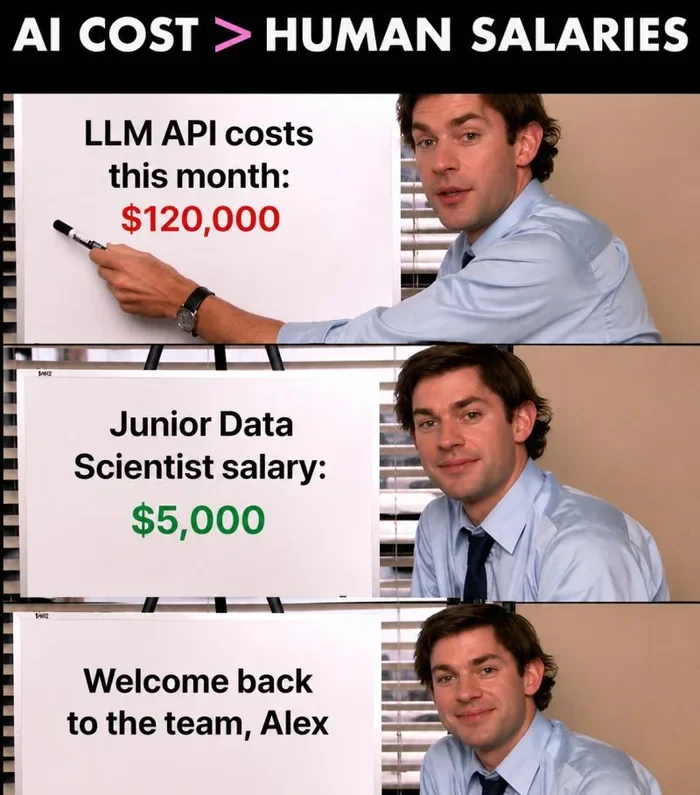
The meme that captured the mood of the cost discussion.
Usage costs are rising, token-based pricing makes spend hard to predict, and expectations keep moving. A meme shared in the session captured the mood: “LLM API costs this month: $120,000. Junior data scientist salary: $5,000. Welcome back to the team, Alex.”
It landed because the tension is real, and in some cases the honest answer is that a particular piece of automation does not pay for itself. From there the conversation widened from spend to impact: energy, water, climate, and what happens to original thinking when people lean on AI too heavily. The example that stuck came from education, where work that relies too much on AI tends to flatten out. The counterweight stayed in the room as well. AI can make work better rather than only faster, when it supports consistency, feedback or fairness.
One pattern underneath all of this shaped the rest of the day. Almost none of the CMS problems described in the room were technical. They were about ownership, structure, priorities and the distance between the people making platform decisions and the people living with them.
What is changing with content
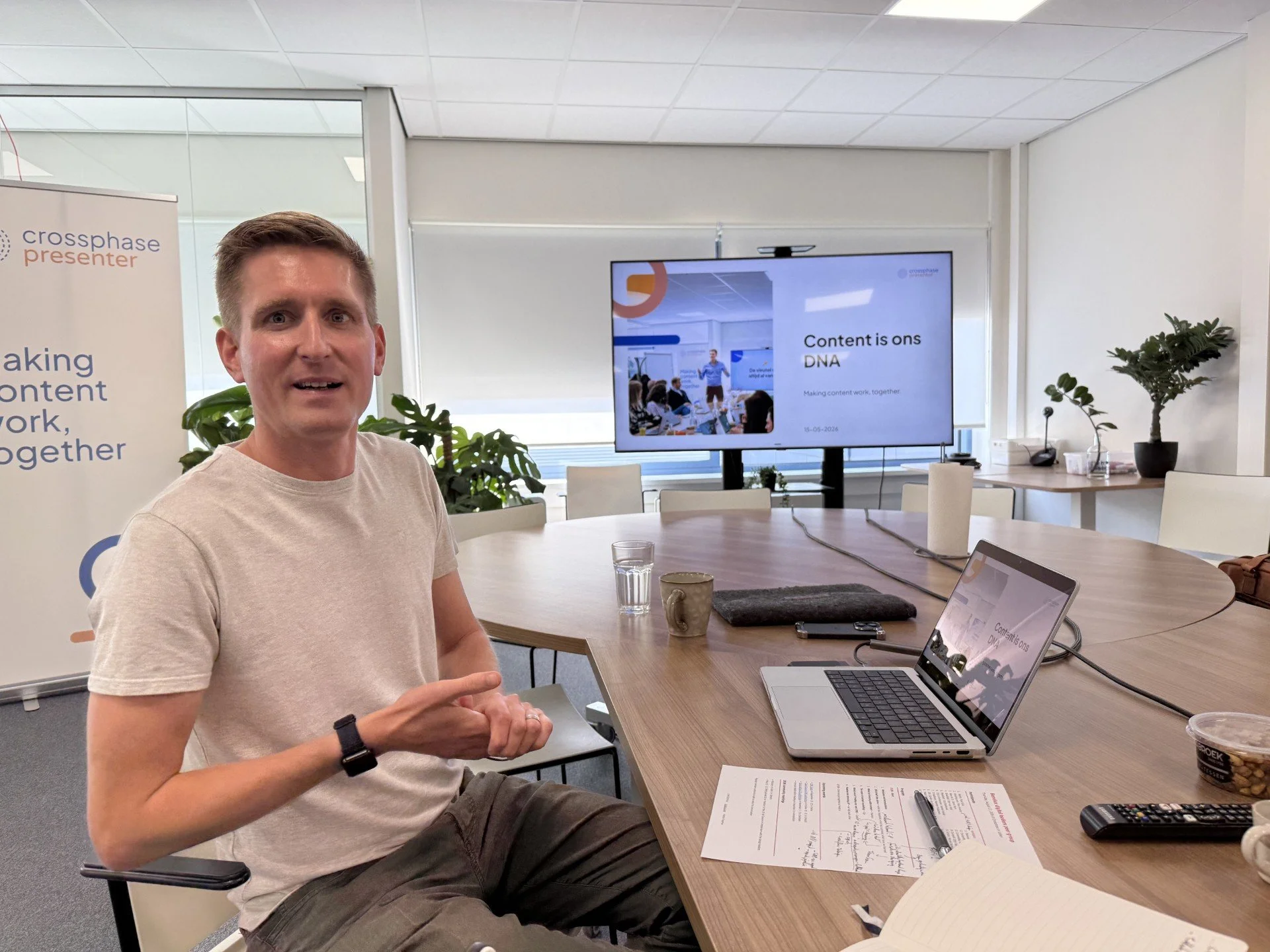
Maarten Fokkelman during his session on what is changing with content.
Maarten Fokkelman, founder of Crossphase Presenter and our host for the afternoon, gave an honest view from inside the content and CMS world: what clients struggle with, what teams worry about, and what it takes to stay useful while content work keeps changing.
His strongest point was that AI adoption is a learning question before it is a tooling question. Teams should build familiarity and real working experience now, instead of waiting for the tools to get better. His metaphor stuck with the room: if you cannot drive, a faster car will not help you.
That connected to a second thread. Content work looks simple from the outside and rarely is. Creating a page in a CMS is learnable in an afternoon, while running content operations inside a large organisation is another matter. Governance, dependencies, workflows, stakeholders and quality control are where the complexity sits, and organisations tend to discover the scale of it late, often once a migration is already running.
Roles are changing regardless of what anyone prefers, and intrinsic motivation varies a lot. Some people start experimenting immediately, while others need much more support to find their place in changing work. There is an uncomfortable side for specialists too: years of hard-earned expertise can suddenly look smaller when a tool reproduces part of the output in seconds. A workshop or a few hours of prompting training will not move a team on its own. Change management, as Maarten framed it, is an organisational challenge as much as a technological one, which is roughly where the first session had arrived too.
Without an understanding of the field, the process and the organisation, the output stays shallow. His practical advice was to keep it small: pick a real use case, learn by doing, and build from there.
He also gave a shoutout to Rafaela Ellensburg and the energy she brings to the field, and shared “Ontdek jouw AI-contentrol”, a quiz built around profiles rather than fixed job titles: jouwcontentrolvanmorgen.nl.
What those teams should be learning about first led straight into the next discussion.
The state of content modelling
The third session opened with a simple question: is content modelling still important? The term covers the work of defining what content types exist, what they contain and how they relate. The answer came out of experience rather than theory. It was a clear yes, with the caveat that the topic usually gets attention only once the pain is there.
The pattern is familiar. Many organisations work from the outside in: start with the design, define the pages, build the flows, and discover later that the structure underneath cannot support reuse, governance or a new channel. Repairing that after implementation costs considerably more than modelling it properly up front.
Why it keeps being pushed aside
Content modelling is concrete and strangely invisible at the same time. Inside the room its effect on maintainability, consistency and migration quality was obvious. Outside that circle, few teams recognise it as a discipline in its own right, and projects have their own gravity:
design gets attention because it is visible
features get attention because they are easy to sell
delivery gets attention because deadlines are real
content structure becomes an afterthought
There is a commercial version of the same problem. Selling this work up front stays hard when the benefits arrive later and the risk of neglect is not yet visible.
The missing role
Does every organisation have a content architect? The answer around the table was a flat no. The responsibility falls somewhere between development, design, product and marketing, and work that sits in the gaps between teams is easy to lose. That made three versions of the same organisational problem in one afternoon.
AI raises the value of structure
The sharpest line made by Janus Boye during the session was also the shortest: ‘‘What you model is what you get’’. This memorable quote is from CMS Kickoff 26, where Marc Salvaterra from ICANN gave an excellent presentation on ‘Why You Need to Know Your Content Better Than AI’.
Set against the earlier discussion about AI-generated answers it gets sharper still. If AI systems are increasingly the ones reading your content, duplicated and inconsistent material no longer gets quietly ignored. It gets repeated back to your audience with confidence.
One question stayed open. As more content gets produced at speed, who helps organisations clean up the result? There may be room for specialists in content architecture and content remediation, even if the market does not yet ask for them by name.
What sounded fairly abstract here became very concrete in the final session.
What’s next? Finding the next CMS
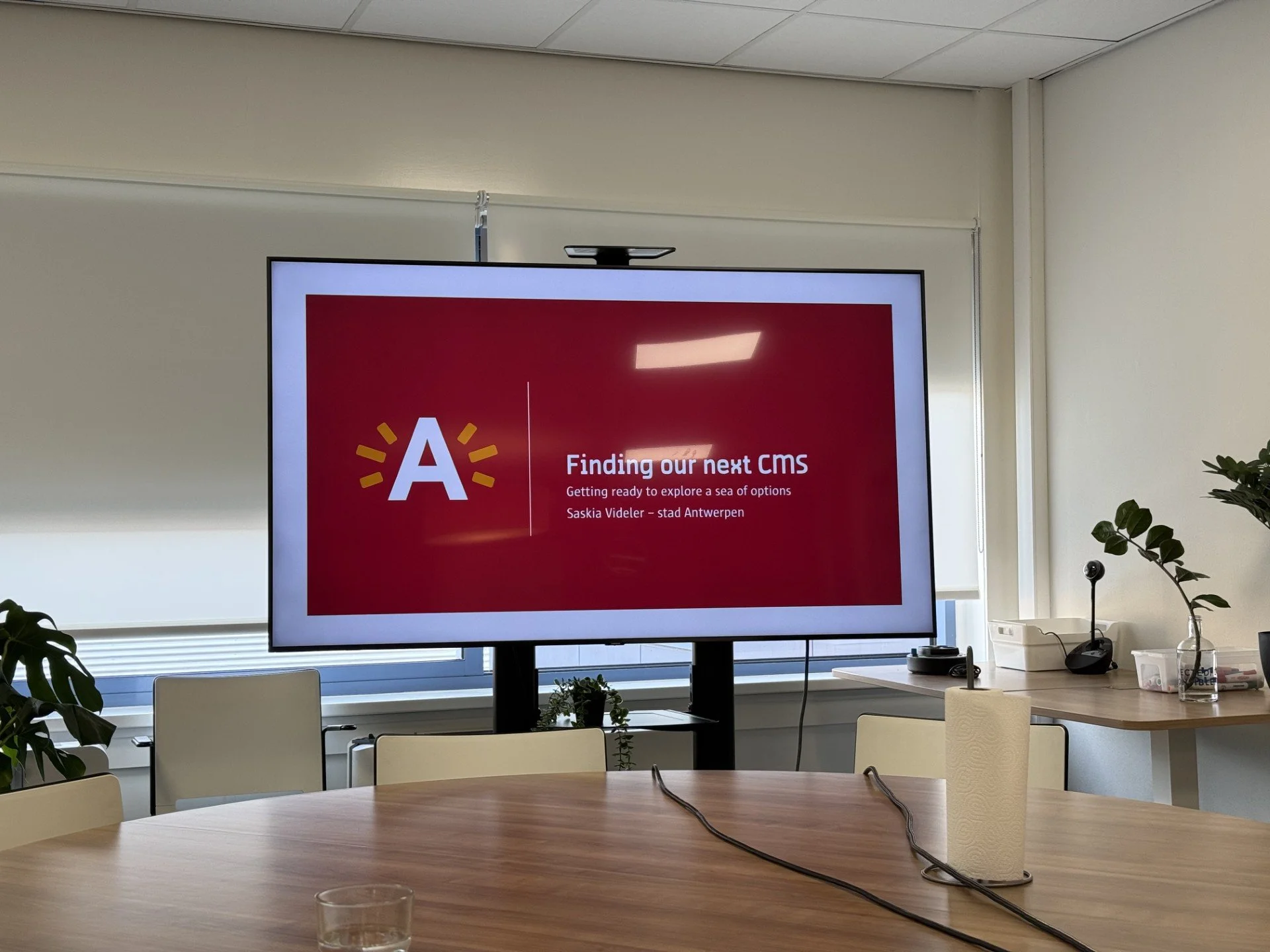
Saskia Videler (City of Antwerp) opening her closing session, Finding our next CMS: getting ready to explore a sea of options.
Saskia Videler of the City of Antwerp closed the day with a question many organisations are wrestling with: what comes next when your CMS landscape has grown fragmented, heavily customised and hard to govern? Her framing made clear that this is an organisational and architectural challenge as much as a platform choice.
Regulatory pressure is part of the urgency. NIS2, the EU directive on cybersecurity for essential services, puts a deadline under decisions that were comfortable to defer. The lesson travels well beyond the public sector. Moments like these accelerate choices and expose whatever was left unresolved in the landscape.
What made the session work was the tone. It read as a reality check from someone in the middle of the work, balancing legacy platforms, internal expectations and legal requirements.
The part I found strongest was the attention given to the semantic layer underneath the platform. Before choosing a CMS there are more fundamental questions about how concepts are named, related and understood across the organisation, and how the same information can travel consistently across channels and departments. That made the earlier content-modelling discussion feel a lot less theoretical. Structure, taxonomy and shared meaning become architectural concerns long before a vendor is selected.
I also liked the willingness to question assumptions before talking products: whether the answer is automatically another CMS, whether the existing channel structure should simply be reproduced, whether platform labels should steer the conversation. Those were deliberately kept open.
The uncomfortable questions came up as well, carefully and with some humour. Whether a website is still needed, what AI changes, what role digital channels will play. Nobody resolved them, which felt right. Fewer direct visits and a greater need for reliable, well-described sources can be true at the same time, and public organisations run into that combination early.
Set against the earlier observation that platforms keep converging on the same middle ground, the more interesting question becomes which partner can help an organisation ask the right questions and execute sustainably. For anyone who has lived through a difficult platform transition, that was familiar territory.
There was considerably more nuance in the room than I can capture in a short recap. It left me thinking that the next CMS decision is not really about the next CMS alone.
What I took away from the afternoon
AI took up plenty of airtime, and the deeper theme of the day was content and organisational maturity. Every session ended up in roughly the same place. An organisation that does not know what content it has, how it is structured, who owns it, where it should be reused and who is accountable for its quality will not solve that by adding AI on top. The tools mostly raise the stakes on questions that were already unanswered.
That shifts what makes a CMS interesting. The feature checklist matters less than the discipline around the content inside it: modelling, ownership, governance, and people who understand both the domain and the systems.
Which gives the question in the title a fairly unglamorous answer. Yes, AI makes content modelling more important, largely by making the cost of skipping it visible much sooner. Perhaps the most interesting effect of AI on the CMS market is that it keeps pushing us back to some very old questions.
Thank you
Thanks to Janus Boye of Boye & Co for bringing the group together and creating the space for this kind of conversation. What makes these afternoons valuable is the openness around the table. People share what is working, what is difficult, and what they are still trying to figure out.
Thanks as well to everyone who contributed so openly to the discussions, and to Maarten Fokkelman and Crossphase Presenter for hosting us in Leiden.