By Janus Boye
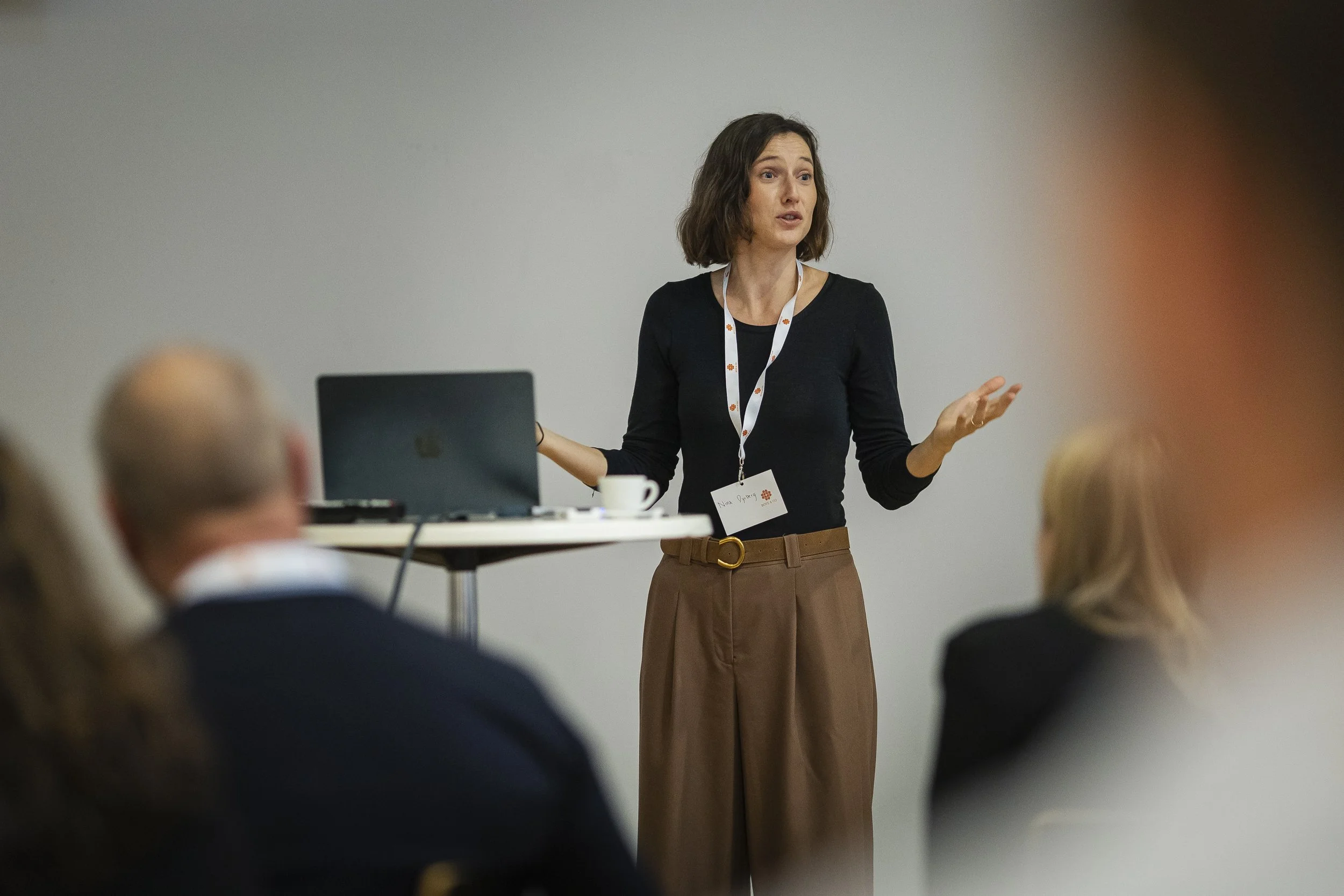
Nina Dyrberg is a Behavioural Design Consultant based in Aarhus. This photo is from her lightning talk at the Boye Aarhus 25 conference. Photo: Roar Paaske
Clear strategy. Strong communication. Leadership alignment.
And yet, change still stalls.
In a recent member call with Nina Dyrberg, the conversation focused on why so many well-intended change initiatives struggle to take hold.
Nina is a behavioural leadership consultant who works with organisations to turn strategy into lived change, focusing on the gap between intention and action.
Organisations tend to assume that once direction is clear, behaviour will follow. In practice, everyday habits, incentives, and social dynamics continue to shape decisions in ways that strategy alone cannot override.
This is where many change efforts lose momentum. Not in the planning, but in the transition from intention to action.
What follows is a summary of the discussion, with the slides and recording included further down for those who want to explore it in more detail.
Nina started by asking a simple but disarming question.
The knowing–doing gap
“Have you ever clearly communicated a change, yet seen people carry on as before?”
It is a familiar experience. The strategy is sound, the message is clear, and yet behaviour remains unchanged.
The question points directly to the knowing–doing gap. Change initiatives often assume that once people understand what is expected, they will act accordingly. In practice, that final step is where most efforts stall.
The progression from said → heard → understood → accepted → acting helps illustrate how far an idea has to travel before it becomes real in practice.
Most organisations invest heavily in the early stages of that journey. Fewer design explicitly for the last.
People act their way into new thinking, rather than think their way into new acting.
This reversal shifts the emphasis. Behaviour is not simply the result of mindset. It is often the starting point.
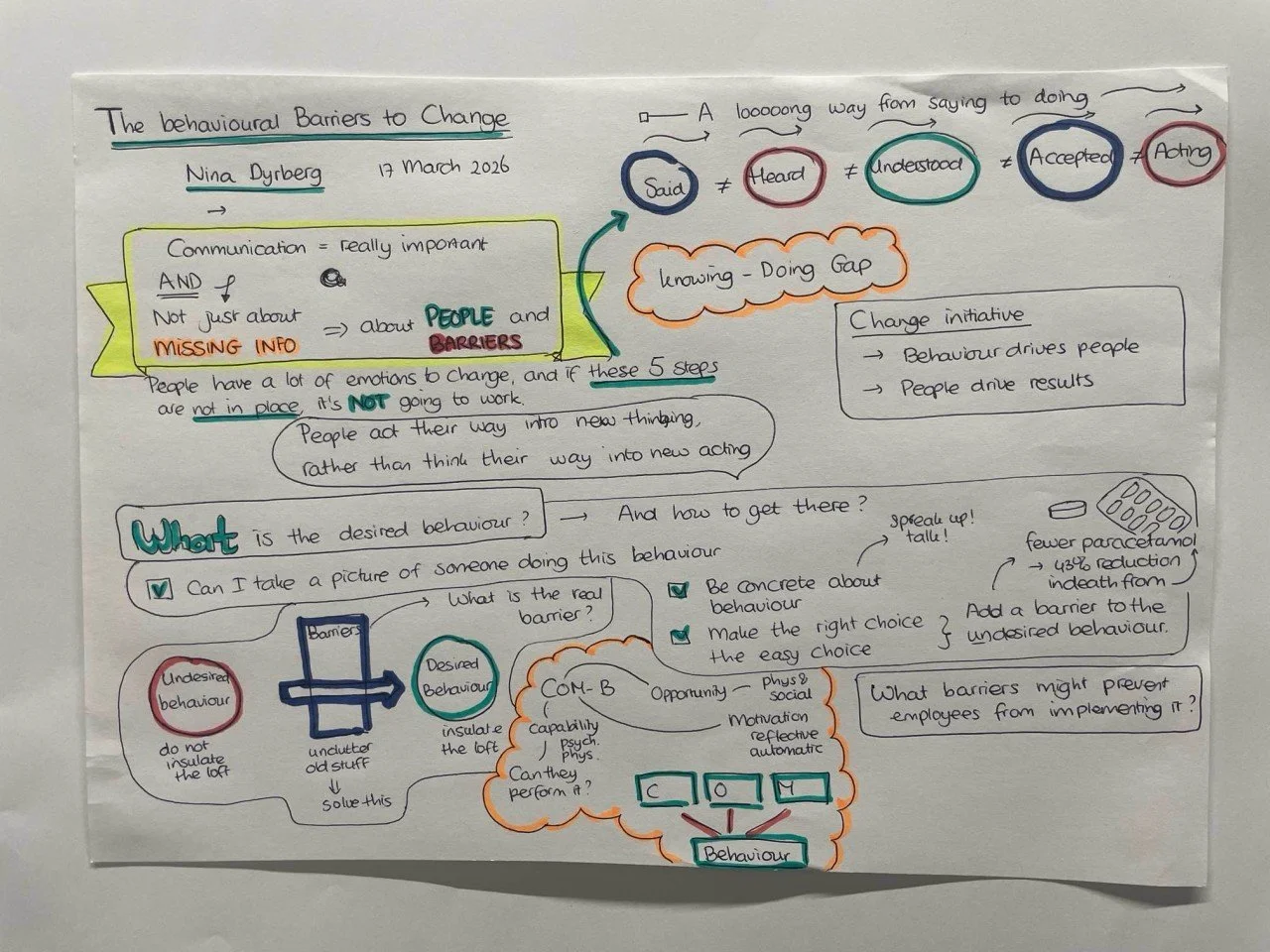
A visual summary of the call as created by Nina Horstra
Defining behaviour
A recurring theme in the discussion was how rarely organisations define behaviour in sufficiently concrete terms.
In many organisations, this shows up in familiar ways. “Improve collaboration” might mean more meetings for one team, better documentation for another, and earlier stakeholder involvement for a third.
Strategies tend to be expressed at a high level. They point in the right direction, but do not translate easily into action. Without that translation, it becomes difficult to support or measure change.
Nina introduced a simple test: can you take a picture of someone doing the desired behaviour?
If not, the behaviour is not yet clear enough.
This test brings useful discipline. It forces teams to move from abstract ambition to observable action, and often reveals that alignment is more assumed than real.
Hidden barriers
Once behaviour is defined, attention turns to what prevents it.
Here, the gap between assumption and reality becomes particularly visible. Organisations often focus on what they believe is the problem, rather than what actually stands in the way.
The example of home insulation illustrates this well. Financial incentives were already in place, and the benefits were understood. The real barrier was more practical: people did not want to clear out their lofts.
When that barrier was addressed directly, behaviour changed significantly.
This pattern appears frequently. The barriers that matter are often small, local, and easy to overlook, yet they shape whether change happens at all.
Designing for behaviour
If barriers are embedded in everyday work, then change needs to be designed at that level.
Two practical principles stood out:
Make the right choice the easy choice
Add a barrier to the undesired behaviour
This approach moves away from persuasion and towards design.
The example of paracetamol packaging is often cited for this reason. Changing the packaging format led to a measurable reduction in harmful behaviour, without relying on additional communication.
In organisational contexts, similar effects can come from defaults, processes, and social expectations that shape behaviour more reliably than intention alone.
Capability, opportunity, motivation
To make this work more systematic, Nina introduced the COM-B model, which frames behaviour as dependent on three elements:
Capability
Opportunity
Motivation
Each of these provides a different lens on why behaviour may not be changing. People may not have the necessary skills, the environment may not support the behaviour, or motivation may be lacking or misaligned.
The strength of the model lies in its practicality. It offers a way to move from general frustration to more precise diagnosis, and from diagnosis to targeted action.
In practice, this shifts the conversation from “why aren’t people doing this?” to more specific questions about what is actually missing.
The conversation continues
Most teams recognise the gap between intention and action. The difficulty lies in working with it consistently and concretely, rather than treating change as primarily a communication exercise.
Shifting the focus towards behaviour does not make change simpler. It does, however, make it more grounded in how organisations actually work. In that sense, the discussion echoed BJ Fogg’s work on behaviour design, which we explored in an earlier member call on simplicity and behaviour change, and connects with more recent conversations in the UX research group on how behaviour is shaped through habits.
If you want to engage further, there are a few ways to continue the conversation:
download the slides from the call or lean back and enjoy the recording
join our free, regular upcoming member conference calls
find a peer group that matches your role and challenges
attend our unique conferences, designed for deep discussion rather than surface-level inspiration
However you choose to engage, we’re glad you’re here and part of the journey.