
By Briana Sim, Founder & CEO, SimpliCity
It's time to stop asking what AI can do, and start asking what it ought to do.
Those tensions surfaced clearly during the recent CMS Experts and Digital Leaders session in Vancouver on March 10, where digital practitioners gathered to share experiences and compare notes on the realities of digital platforms, content systems, governance, and AI.
These gatherings are intentionally small. No stage. No selling. Just a room full of people who spend their days dealing with complex digital systems and organizational change.
And when the right people sit around a table together, the conversation tends to get honest very quickly.
Learning from a Room Full of Peers
One of the things that makes the Boye & Co community special is the diversity of perspectives around the table and the format that unlocks them. No stage, no one-way presentations, no sales pitches. Just digital leaders and content practitioners across sectors sharing what's working, what isn't, and what they're still trying to figure out. No single organization has all the answers right now, and that shared humility is exactly what makes peer learning in a room like this so valuable.
It was great to have municipal and public sector peers at the table: Patricia Sagert from the City of Maple Ridge, Ron Boaz from the City of Vancouver, Jodie Delore from TransLink, and Ksenia Cheinman from Fisheries and Oceans Canada. Joining them from across Vancouver's broader digital community were Alka Tandan from Reframe & Refine, James Cornford from Telus Digital, Tim Harnett from Simpler Media, and Morten Rand-Hendriksen from LinkedIn Learning. And rounding out the room, composable CMS platform perspectives from Ian Sim and myself from SimpliCity, and Jon Voigt from Agility, who made the trip in from Kelowna.
Janus Boye has spent many years building this global community of digital leaders, and the Vancouver session reflected that same spirit of open exchange. A special thank you Janus for coming all the way from Denmark, and to Mark Demeny, who travelled from Ottawa to co-host the session. Mark has long been part of the CMS Experts community and brings deep experience across content platforms and enterprise digital strategy.
Setting the Stage: Responsible AI and Organizational Pressure
Some of the most thought-provoking discussions of the day were led by Ksenia, followed by Alka, about responsible AI and the real pressures many organizations are feeling right now.
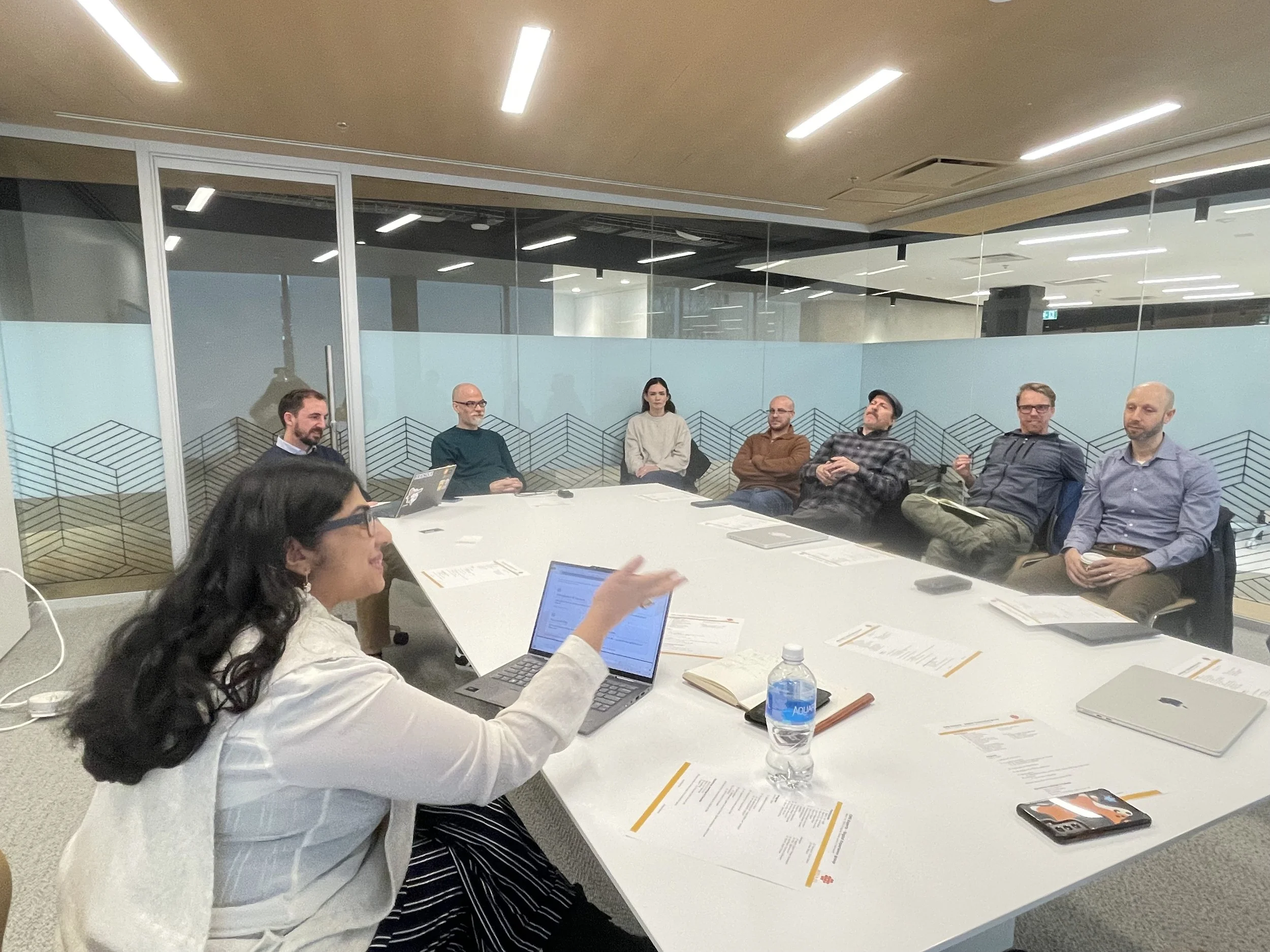
Alka Tandan getting the conversation started on responsible AI
Across sectors, many teams are being asked to adopt AI tools quickly, sometimes before governance frameworks, evaluation methods, or long-term strategies are fully in place.
The discussion explored questions many digital leaders are asking:
How do we adopt AI responsibly while still moving innovation forward?
How do we maintain human-centred digital experiences as automation increases?
How do organizations balance innovation with risk management?
Rather than focusing on AI hype, the conversation centered on practical realities inside organizations today.
Several participants shared the tension of leadership teams eager to explore generative AI, while operational teams work to ensure that experimentation happens thoughtfully, responsibly, and with purpose.
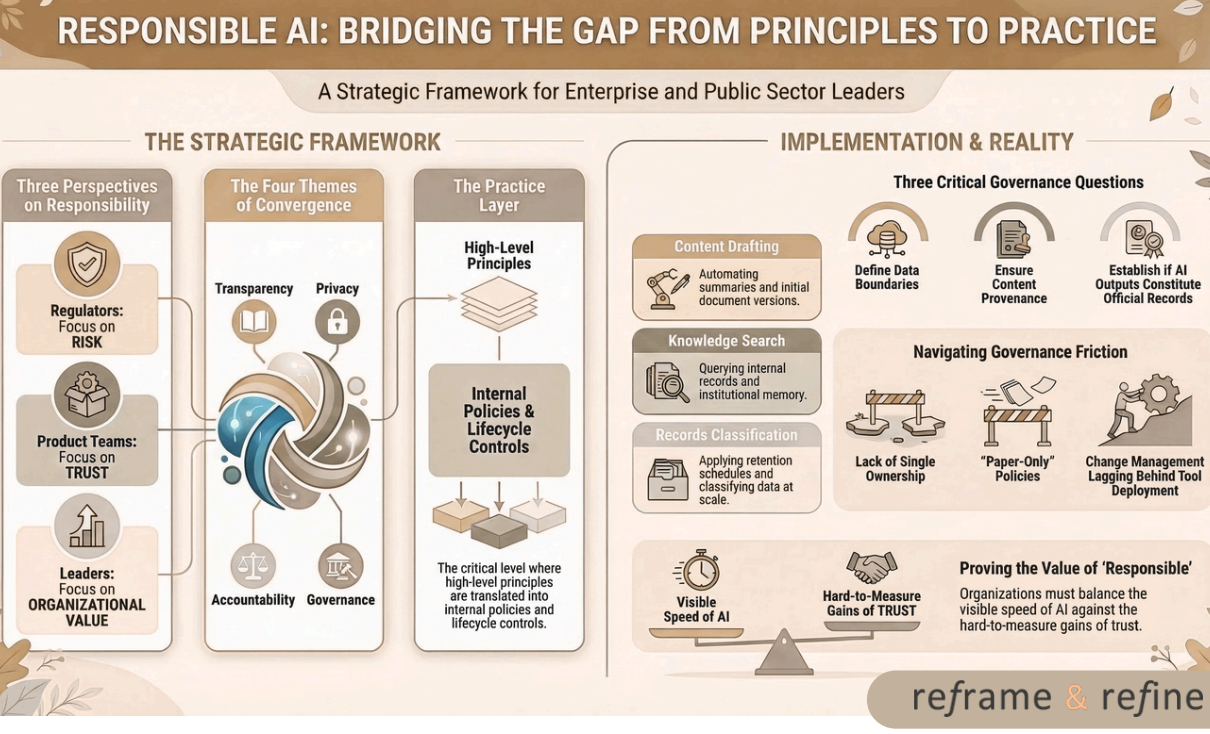
Responsible AI: an implementation-oriented overview by Alka Tandan
It was a valuable reminder that AI adoption isn’t only a technical challenge. It’s also a governance, organizational, and cultural challenge.
Human Judgment Isn’t Going Away
Of course you can’t discuss responsible AI without tackling the role of human oversight in AI-driven systems.
AI tools are improving rapidly. Tasks that used to require significant manual effort like surfacing outdated content, assembling reports, and generating variations of copy are increasingly automatable.
But organizations still aren’t equipped to fully remove humans from the loop, and I’d argue nor should they.
For many teams, the current model looks more like:
AI assists → Humans review → Humans approve.
That checkpoint matters, particularly in sectors where trust and accountability are critical.
For example:
Public sector teams must consider real-world consequences of errors.
Content teams worry about misinformation.
Research teams want to ensure participants and communities aren’t misrepresented.
The consensus wasn’t anti-AI.
If anything, most people around the table are actively experimenting.
But there was strong agreement that AI works best as an assistive layer, not a replacement for judgment.
Content, Platforms, and the Next Phase of Digital Systems
A concept that surfaced during the session was the evolving idea of the “content supply chain.”
Mark shared early perspectives from his upcoming book with Deane Barker, which explores how digital platforms themselves are evolving as content becomes more structured, reusable, and interconnected across systems.
Content is no longer just something published on a website.
It increasingly functions as structured information that can flow across systems, powering:
Multiple channels and experiences.
Search and discovery.
Automation and personalization.
AI-assisted workflows.
This shift raises new questions about how organizations design and manage their digital platforms.
As AI becomes more integrated into digital tools, the relationship between content models, governance, and platform architecture becomes even more important.
Several participants noted that many organizations are now rethinking how their systems should evolve to support this new landscape.
For those of us building modern composable CMS platforms in Canada, like SimpliCity for municipalities and Agility for enterprises, this evolution reinforces exactly what we've been designing toward: content as structured data that can move flexibly across services and experiences.
Digital Sovereignty and the Canadian Context
Speaking of Canada, we then turned to a timely conversation exploring the growing focus on digital sovereignty, particularly within Canadian organizations and public sector environments.
We discussed the increasing attention being paid to:
Where digital infrastructure is hosted.
Long-term platform flexibility.
Procurement policies and technology choices.
Open source versus proprietary models.
While these discussions often appear technical on the surface, they ultimately connect to a deeper question:
How do organizations maintain control and resilience over the systems that power their digital services?
For many teams, answering this question is becoming an important part of long-term digital strategy.
A Personal Perspective from the Municipal Sector
As someone building technology specifically for municipalities, the themes from this session weren't abstract. They're conversations we have with local governments regularly.
Municipal teams are being asked to deliver better digital services while managing increasingly complex technology landscapes. Content systems, service platforms, integrations, and citizen expectations are all shifting at once. And unlike large enterprises, most municipalities are doing this without massive IT teams or unlimited budgets.
That's the gap SimpliCity was built to close: a digital services platform built upon a powerful composable CMS designed specifically for local government, Canadian-built, Canadian-hosted, and shaped around how municipalities actually work. At a moment when digital sovereignty and data residency are becoming real procurement considerations, that matters more than it used to.
We're also excited to share that two new municipal founding partners have recently joined SimpliCity (you heard it here first!), and seeing that community grow is exactly the kind of signal that tells us the timing is right.
The conversations in this room reminded me why our work matters. Municipal digital services touch real people's daily lives. Getting them right isn't just a technology question. It's a public service question.
Learn more - be a part of the conversation
The conversation naturally continues in our peer groups and at our conferences. Join us, share your progress, get help when you are stuck and be a part of delivering better solutions together with the broader community.
It’s been a year since we held our Vancouver kickoff hosted at TELUS Gardens. Here’s Briana’s: Recap of Vancouver CMS Experts kickoff.
We’ll be back in Vancouver again soon, but there are also many other upcoming local group meetings in the coming months, including in Ottawa, Toronto and Montréal.