“A computer can never be held accountable, therefore a computer must never make management decisions.”
Thomas Dugaro put that IBM line on the screen in our Employee Experience track at Godsbanen in Aarhus last week. It’s 47 years old, and it landed in the room like it was written last month.
Much of what I heard and felt at the Boye Aarhus 26 conference was about humanity. Of the three talks in my track, none led with AI. Even Steven Pemberton’s keynote on vibe coding, from a man who helped design the language Python is based on, came back to us as humans and how we stay in control.
There’s a feeling in my gut that people are longing for the human side of the work we do. A few years ago we couldn’t wait for the next transformation, and now it seems we want something simpler: connection, and a way to make better decisions without off loading them to said computer.
When I went back through my notes, the talks kept circling three things we’re at risk of handing over: our decisions, the process of actually doing the work, and each other. The question beneath all of them, I feel, is “what do we keep for ourselves?”
Keeping our decisions
Thomas Dugaro’s talk was really about decisions as the thing employee experience is built on. A decision without action, he told us, is just a nicely documented intention. He also made a point I’ve kept thinking about since: every decision is a decision against something, and the options you said no to don’t go away. People keep coming back to them.
He walked us through a menu of five pairs for how a group can decide: central or decentral, consent or consensus, autocratic or democratic, consultative or delegated, and deciding not to decide or leaving it to chance. None is better than the others. The real skill we should develop is picking one on purpose and saying out loud which one you’re using (communication is a wonderful when used well). Mixing up consultative and delegated, where a leader asks for input but quietly keeps the decision, is where a lot of the frustration between senior and middle management starts.
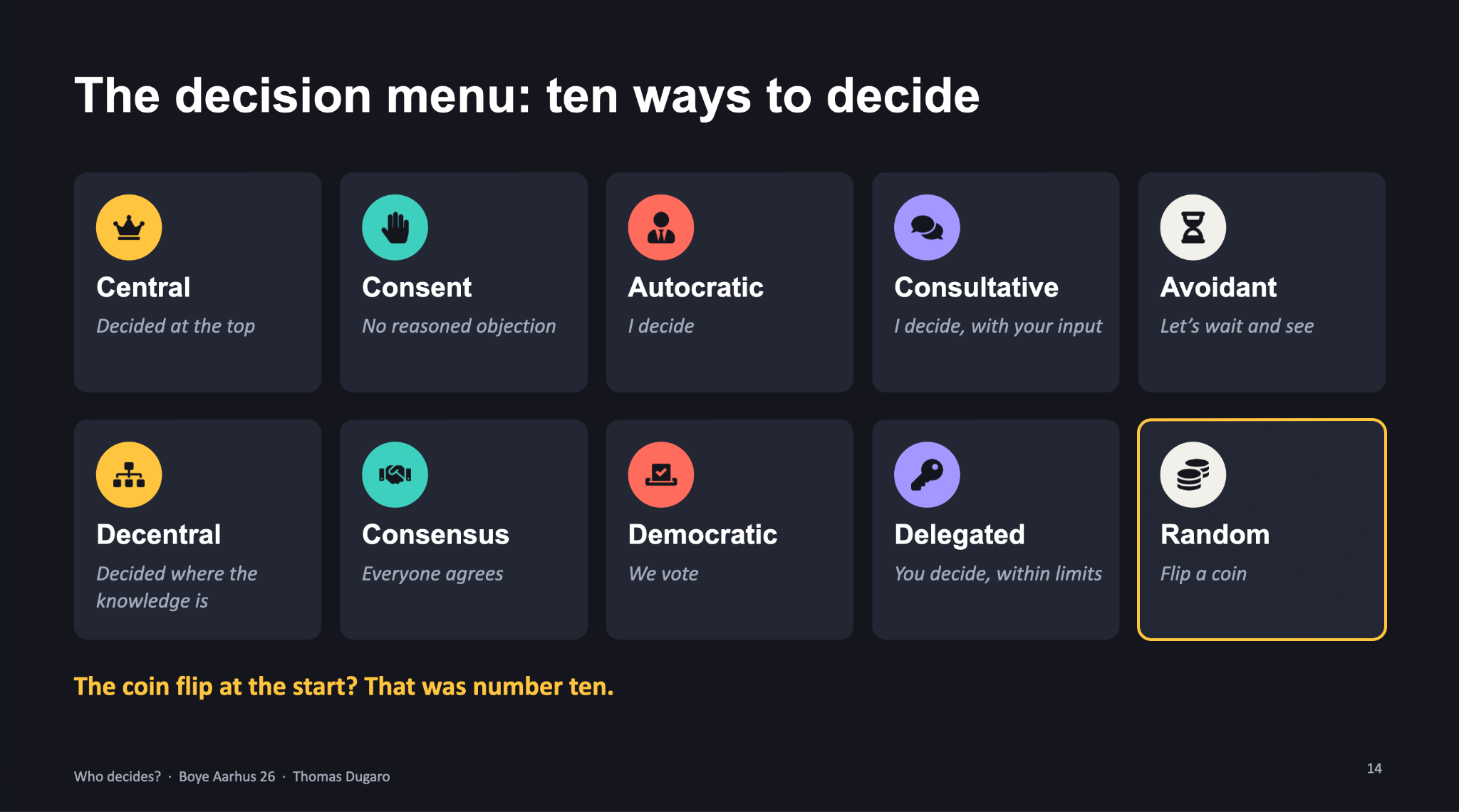
Thomas Dugaro’s decision menu: ten ways to decide
What stayed with me most was how he tied it to how work feels. Too many unclear calls burn people out. Never being consulted disengages them. And when decisions are always unclear, heroes show up to fill the gap. He saw all three as design problems in the organization rather than problems with the people. (This is something I believe most companies suffer from. Poor organizational design.)
Then he got to AI. It’s now a quiet participant in almost every decision, and the reasoning behind a choice is disappearing into prompts nobody else can see. His suggestion was to treat those prompts as a new kind of decision record, and to keep the pen in human hands for the calls that carry high stakes and real meaning for people. (He also introduced me to Herbert Simon’s word “satisficing,” settling for good enough instead of chasing the best. AI, he said, pushes us toward chasing the best, because it keeps showing us one more option to compare.)
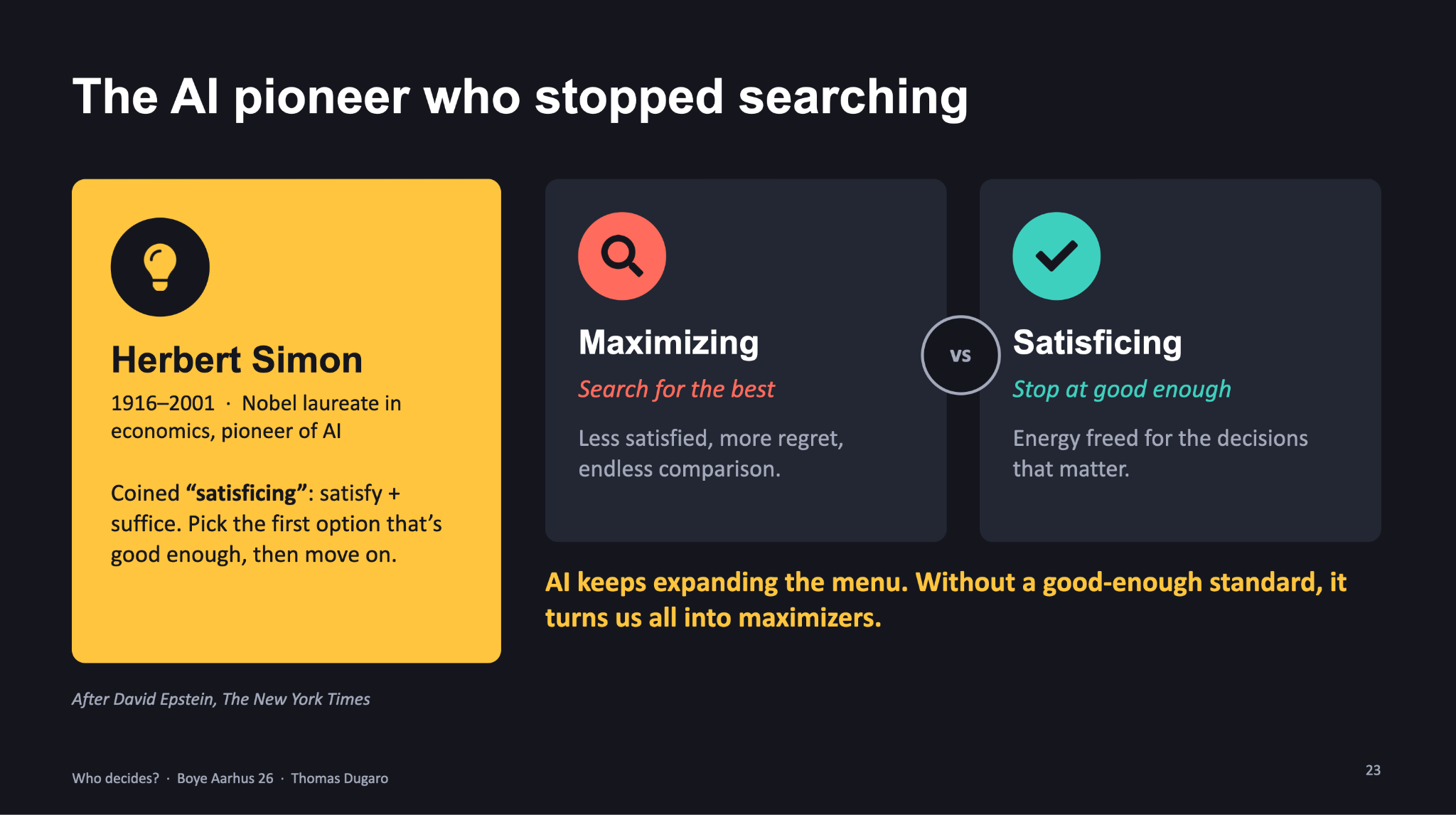
Thomas Dugaro on Herbert Simon and “satisficing”
Tobi Stadelmaier came at the same problem from three places where a bad decision costs more than a meeting: a cockpit, an intensive care unit and a mountain expedition. In an ICU, waiting is expensive, so doctors act broadly and reverse course once the results come back. On an expedition, the team agrees at base camp who decides, because at 8,000 meters judgment is at its worst. One anti-pattern he named from software teams was running a Slack poll during a production outage, which is consensus in the middle of a crisis. He borrowed a line from a German Eurofighter pilot: a decision nobody heard is no decision.
Nina Dyrberg picked up where Thomas left off, with what happens after the decision. Most strategies fail, she said, because people don’t change what they actually do. Her test for whether a goal is specific enough was simple: could you film someone doing it? “Managers need to communicate better” fails. Asking more questions, or listening without interrupting, passes. And her question for leaders is worth stealing: who needs to say and do something differently for us to get these results?
Keeping the process
Steven Pemberton, someone whom I like to call one of the fathers of the internet, spent a year getting AI to rewrite programs he had already written himself: a programming language, a text processor, two web editors, a server and a slides program. The slides program took eight rounds before it was usable. In one test, the AI turned a 900-line program into 2,000 lines, and he took his own original down to 350.
His warning was about what happens to the people. Coders who stop coding lose the ability to judge what the AI hands them, and he compared it to Americans who love apple pie but have never baked one. His bottom line was to say exactly what you want, keep humans involved before anything ships, and test, test, test.
Thorsten Jonas took a train from Hamburg to Zaragoza, and then biked 30 km into the desert to watch the solar eclipse this summer. Only to find that the spot he was headed to was actually fenced off (it turns out these things sometimes don’t show up on Google Maps). So he had to course-correct, found a new spot, and ended up with an even better view and watched all 100 seconds of it. His whole point was that the value of it all lies in the journey, and when AI hands you the result without the part where you learn something, we are headed in the wrong direction.
He also gave an example of a developer who let AI write all his code for three months and then couldn’t confidently change his own product. Even with 25 years of experience. He also cited research on doctors using AI to spot cancer in MRI scans. They got better with the AI, and worse than their old baseline once it was taken away. This is another warning that we need to make sure that our minds are not taken away and our good judgment along with it.
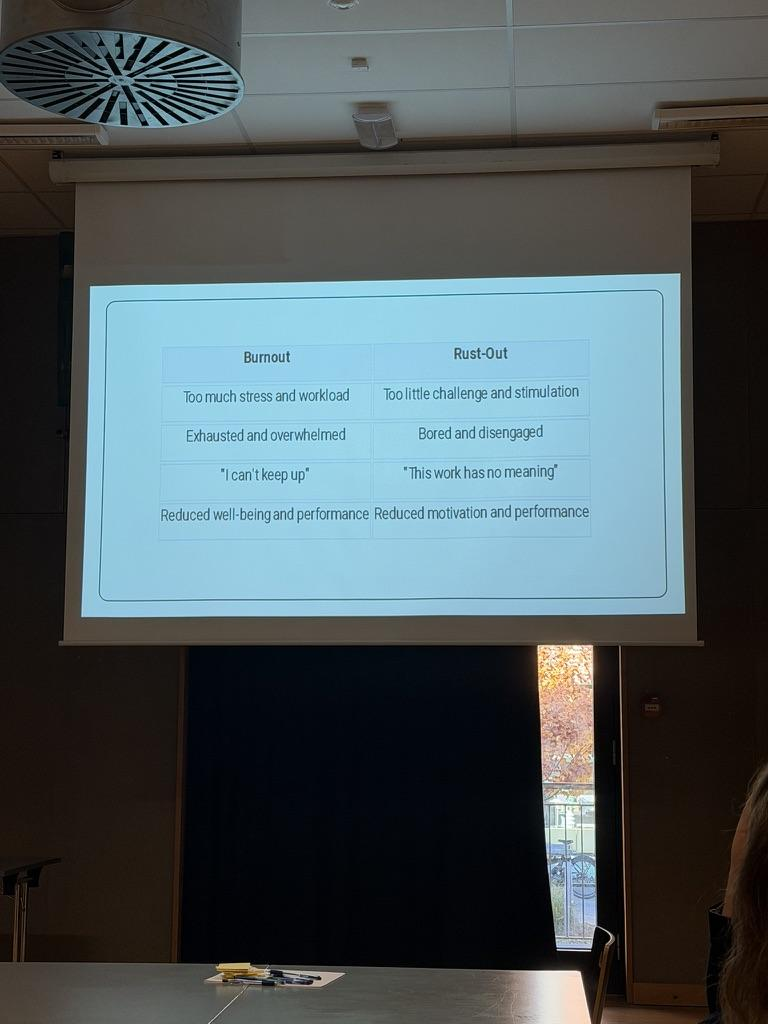
Melissa Ekin Brigante’s workshop on burnout and rust-out
I immensely enjoyed Melissa Ekin Brigante’s workshop. Burnout, she said, comes from too much demand, and rust out from too little challenge or meaning. She ran it as a live experiment. We each drew a circle with two arms and wrote what felt like too much on one and too little on the other. In our room, the too-little side held autonomy, trust, direction and focus time, and the too-much side held meetings, admin, messaging channels and silos. The “just right” zone was the hardest part to fill in, which she put down to negativity bias. It turns out, while we are suffering on the other two sides, we’re somehow afraid to make the adjustments to make life and work just right
Her AI point connects straight back to Thorsten and Steven. Studies show AI frees up time, but people fill it with more repetitive work, and that pushes them toward rust-out. Her fix was small on purpose: each week, take one concrete thing off each arm. And when it’s hard, go easy on yourself, because the cause is often what she called a system error rather than a personal failing.
Keeping each other
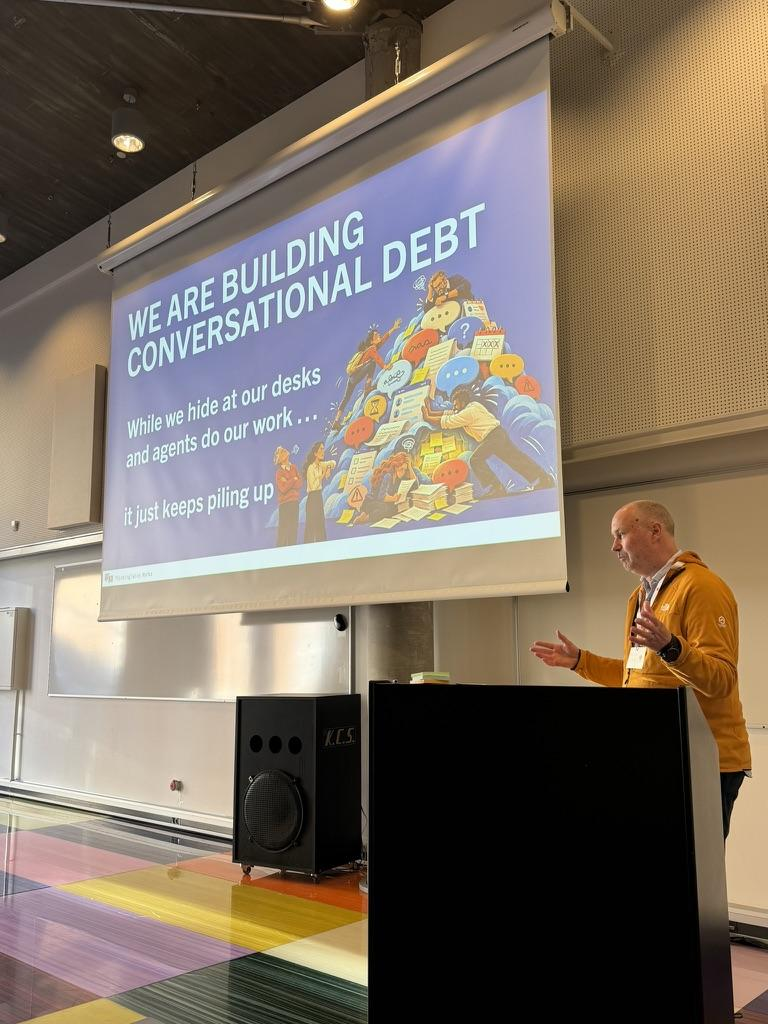
Morten Elvang: “We are building conversational debt”
Morten Elvang talked about a problem that has been invading our work and life space the past few years. He calls it “conversational debt”. It builds up when a colleague answers your question with “ask Claude” or when someone sneaks off to the coffee machine to avoid people and then vents to ChatGPT instead, or when a decision gets held back with “we’ll tell you later.” There’s only one way to pay it off, and that’s through actual conversation. His answer is to vouch for your own piece of the work and invite people to challenge it. Ask that kind of colleague about their work and, instead of “ask ChatGPT,” you hear something like: “Oh wow, you’re interested in my work? Let me tell you about it. What do you think?” He’d go further, too: don’t wait for the questions, go test your work against other people’s.
Julian Mills calls the white space, the gap between culture, technology, communications and knowledge management that no department owns. If you’ve ever run a large tech project, you might know that companies need employee experience to work across functions, but they fund, measure and reward work inside them. What should be extremely collaborative ends up being extremely siloed. So that space ends up being filled by the heroes or the people who are willing to take the risk that they might not be rewarded for. Julian’s point immediately made me think of one of my favorite work quotes by Upton Sinclair, “It is difficult to get a man to understand something when his salary depends upon his not understanding it.” I can’t tell you how many times I have thought of that quote while working on a big tech or transformation project over the years.
Julian gave some practical advice that any “hero” can use: show the decision maker the problem that needs to be solved in a way that they can see. He told the story of a strategic director who piled 100 different factory gloves on a boardroom table, and the executives they were trying to win over. Immediately saw the waist in front of them. Another team stapled a screenshot of an error message to the front of a business case for the CFO. And don’t talk dolphin. Translate what you know into the language the people who decide actually use.
Antonia Fedder started her talk way back in the 1950s, when US Air Force planes kept crashing even though pilots followed protocol. The Air Force measured 4,000 pilots across more than 100 dimensions to find the average of a pilot. Not a single pilot matched. The fix was an adjustable cockpit, which, funny enough, is why your car seat moves today. (which, in turn, reminds me of the book “Invisible Women,” which talks about women not being considered in the fitting for things like car seats. Bias is everywhere). Something built for the average, she said, is built for no one. Her point for us was that design is never neutral, and that AI inherits the bias already in our data and decisions and scales it. She closed by turning the golden rule around: treat people the way they want to be treated.
And then there was Johanna Halfmann, who gave the shortest (and possibly the most powerful) talk of the day. Her answer to the question of what we keep was simple: no to AI. She’s speaking out about it because the market, our teams and our budgets all seem to be betting on AI, and saying no out loud adds to the conversation and changes behavior. As far as we know now, she said, AI isn’t legitimate, it isn’t healthy and it isn’t right, and we have choices that let us explore alternatives.
I don’t wholeheartedly agree with her. I’ve said for a while that saying no to AI is how you lose. But I have a lot of respect for her for standing up in that room and saying it, because she put words to the unease a lot of people are feeling right now.
The part we can't hand over
Going back to that IBM line, the word that stays with me is accountable. A computer can’t be held accountable, so somebody has to be. Every talk I heard last week was, in its own way, about keeping that somebody in the room: the person who decides, the person who does the work and learns from it, and the person across the table you actually talk to.
I love the feeling I get when I’m hosting speakers like this. The people are real, and it reminds me that no matter how much technology takes over, bringing people together is the most important thing.