By Janus Boye
Our annual collab meeting returned to Hamburg in late November this time hosted by our friends at adesso. The atmosphere was exactly what makes this community special: curious, informal, quietly ambitious and rooted in shared practice.
People arrived from around Europe and across industries and regions, filling the room with a mix that has become a hallmark of these meetings. Enterprise leaders from Adobe, Hapag-Lloyd and SAP sat alongside public-sector teams from Hamburg and Schleswig-Holstein, product companies like Cognigy, CoreMedia, Staffbase, and StreamX, and a strong delegation from agency members including B13, Diconium, Monday Consulting, and Sitegeist. The result felt less like an event and more like an inspirational working session with friends.
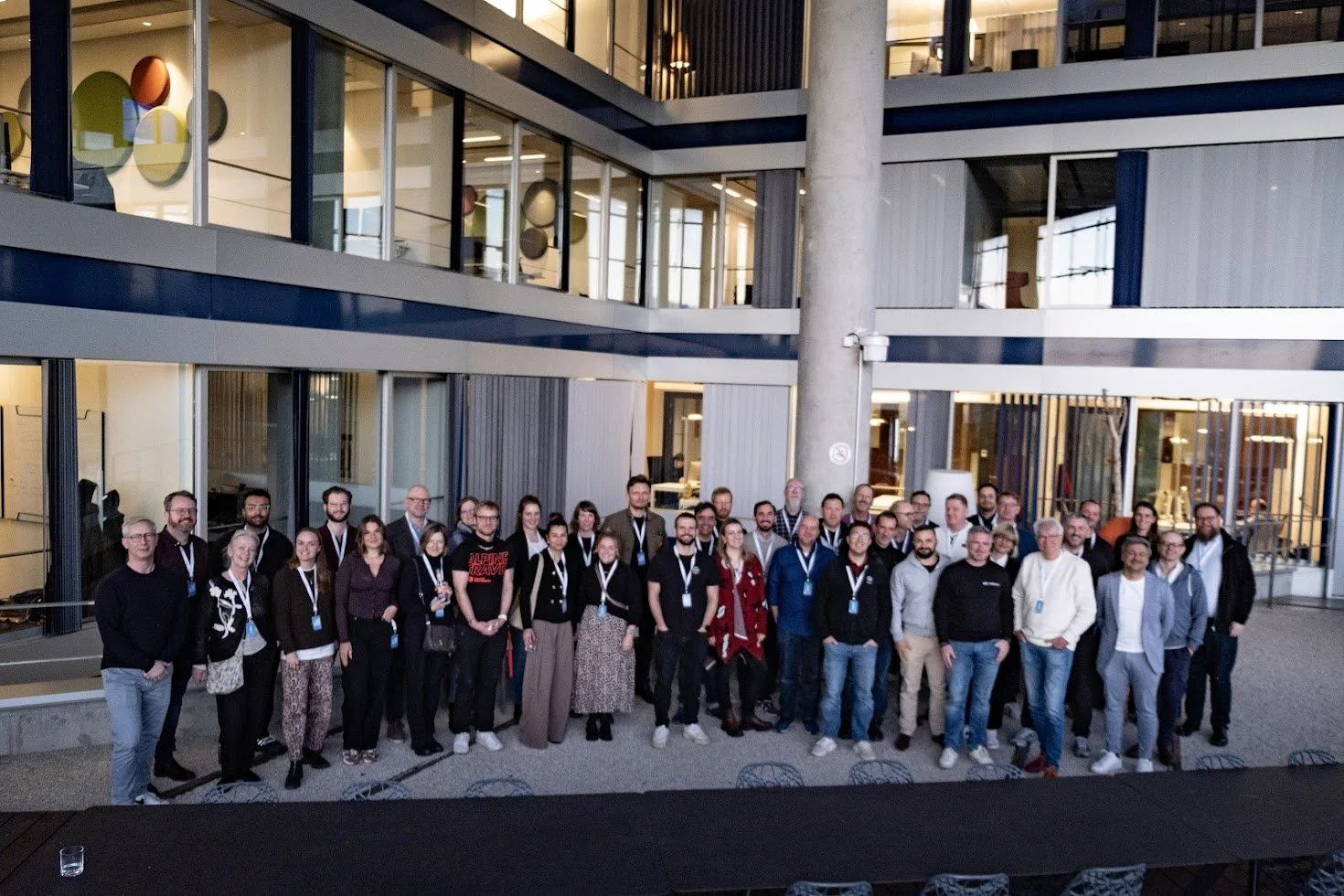
A big group at Adesso HQ very centrally in Hamburg for our annual collaboration meeting held on November 20, 2025
This year’s agenda reflected the shifts we are all navigating: AI’s growing influence on design and content, new expectations in public services, the ongoing grind of accessibility, the realities of governance and compliance, and the very human work of values, culture and craft.
Below is a talk-by-talk reflection and you can jump directly to any session using the table of contents:
Opening, welcome and reflections for 2026
We opened with our host Klaas Klaassen, who leads UX consulting and project management at adesso DX. Besides welcoming us, his presentation looked into how his team approaches digital experience work. He introduced adesso DX as a fully integrated digital experience agency, where strategy, design, technology and operations sit together and support each other. What matters most, he noted, is not the scale of the organisation but the way disciplines combine to create value.
He walked us through their guiding philosophy: design the right thing before designing the thing right. Using the double diamond as a shared visual language, Klaas showed how experience strategy flows into solution design and then into development. It was a reminder that great UX is never an isolated task but a continuous collaboration. UX consulting, user interface design, UX coding and project management all reinforce each other.
From there, Klaas shifted to mindset, which he framed as the real differentiator for the work ahead. In his view, UX acts as a servant leader, helping disciplines connect and move together. He then shared what he sees as the essential ingredients for doing well in 2026: competence combined with intuition, courage combined with passion, and ownership combined with team spirit. These qualities, he said, are what have carried adesso DX through past challenges and what will help teams navigate the accelerating shifts around AI, productivity and the move toward product thinking.
Klaas closed with three questions for the group:
What have you established in the last three to five years?
What will you tackle next?
Which attitude will support you as you take the next step?
Using whiteboards and dividing us into groups, he created a reflective opening that encouraged participants to think not just about tools and trends but about the personal and team qualities that will matter most in the year ahead.
For more details, see his slides (PDF).
Agentic AI reality check
Marc Schneider from software firm Cognigy offered one of the clearest explanations of agentic AI we have heard this year. With his firsthand experience with organisations actively deploying agent-driven workflows rather than simply talking about them, his message was both pragmatic and hopeful:
Agentic AI is not magic, nor is it far-off theory.
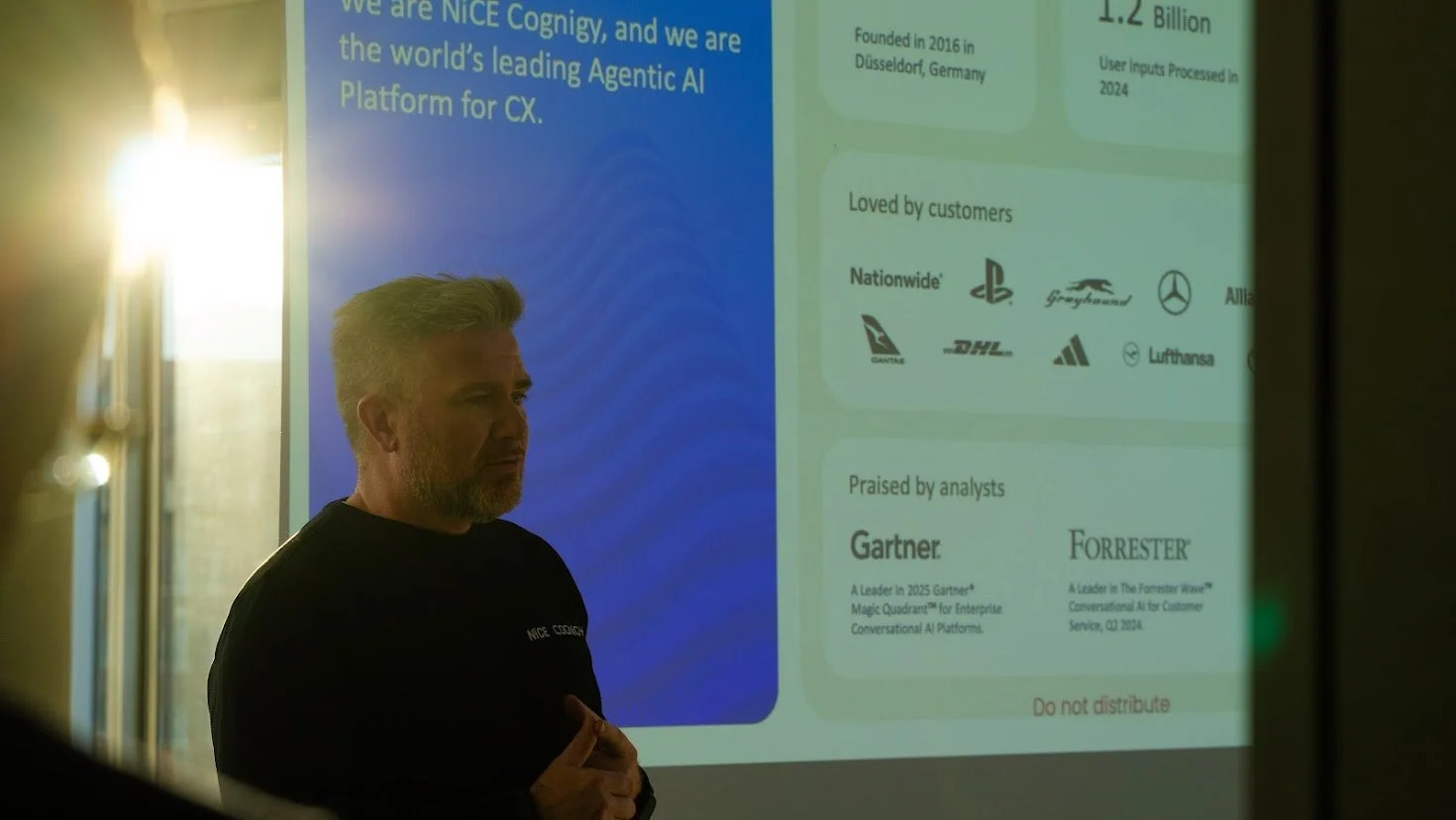
Cognigy offered an agentic AI platform for customer experiences
With the customers at Cognigy, agentic AI is already working in specific, use cases, in particular around customer service, but only when paired with disciplined processes and strong data foundations.
He showed how many AI initiatives fail not because the models are bad, but because the surrounding systems are messy. Enterprises often underestimate the orchestration required: governance, handover logic, fallback paths, testing frameworks and clear boundaries. This also goes for the generative and conversational AI customer service agents that Cognigy offers. Marc emphasised that hype cycles tend to obscure the truth that agentic systems behave unpredictably when poorly scoped.
Ultimately, he argued that success in 2026 will come from teams who approach AI not as something to “bolt on”, but as a capability that must be designed, constrained and supervised like any other operational system. In brief:
Agentic AI works, but only when expectations, boundaries and underlying processes are mature.
The UX value shift in the age of AI
Joining us from German software giant SAP was UX Innovation Lead Vladimir Schneider, who covered the big question on the mind of many designers right now:
Will UX thrive like the French Bulldog, today's most popular breed? Or fade into rarity like the nearly-extinct Otterhound? Or is there a completely different future waiting for us?
He highlighted that as interfaces become more dynamic and predictive, the designer’s craft increasingly shifts from screen-level design to system-level orchestration. Instead of controlling every detail, designers must now shape flows, feedback loops and behavioural patterns that evolve over time.
As he said:
“If AI enables anyone to make things usable, our job moves from making experiences functional to making them truly unforgettable”
He explained that enterprise UX in particular is being transformed by AI-enhanced tooling and intelligent assistants embedded in core workflows. This changes what users expect: not just clarity, but guidance; not just consistency, but adaptation. The role of UX expands into trust-building, ethical guardrails and designing for edge cases where AI may misinterpret intent.
Personally, I also enjoyed that Vladimir pushed us to look a bit further into the future: He brought 2030 predictions on new jobs created according to the World Economic Forum.
Vladimir reinforced that the future designer must be comfortable with ambiguity, data and continuous learning. The tools will become faster and more automated, but the responsibility for shaping meaningful, humane experiences grows heavier. He left us with these three questions to ponder:
What's signal and what's distraction?
Where does UX value actually move next?
What should we do now to shape the future instead of reacting to it?
In summary: AI elevates UX from designing screens to designing behaviours, trust and long-term system dynamics.
The future of designers with Figma Make and other AI tools
We stayed a bit more with design leadership, where Stephanie Weber from Fielmann brought an inside view of what happens when AI-driven design tools like Figma Make land in a real organisation. Fielmann’s design team is already experimenting with automated UI generation, exploration and prototyping and Stephanie also titled her presentation:
From Pushing Pixels to Orchestrating Experiences
which nicely summaries her presentation, although as she said, the UX work was naturally never just all about pushing pixels. You can also download the slides (PDF), where you will find on slide 8 our results from the alternate use test that we did together in the room. In brief: The creativity was high in the room, when it came to other uses for a cup.
What struck many in the room was her candour: The AI tools does make some parts of design radically faster, but they also introduce new coordination challenges.
She walked through how Figma Make can turn a text description into multiple design variations within seconds, reshaping the ideation process. Designers spend less time pushing pixels and more time interpreting, aligning and deciding. But as she noted, the democratisation of design — where product managers, engineers and others can generate prototypes independently — creates both opportunity and tension.
Stephanie explored emerging roles, such as “Experience Orchestrators”, who connect strategy, systems and team alignment. She also stressed the importance of curiosity and critical thinking: AI can generate patterns at speed, but only humans can recognise when something meaningful is missing.
Accessibility in the real world
Joining us from Stuttgart was Florian Keitgen from TYPO3 agency B13. His talk was grounded, honest and refreshingly practical. Speaking from B13’s experience supporting TYPO3 clients, he described a landscape where everyone has known the accessibility issues for years — but momentum only emerged as regulatory deadlines approached. This was the summer of European Accessibility Act compliance. Big interest leading up to the June deadline and since then it has somehow faded.
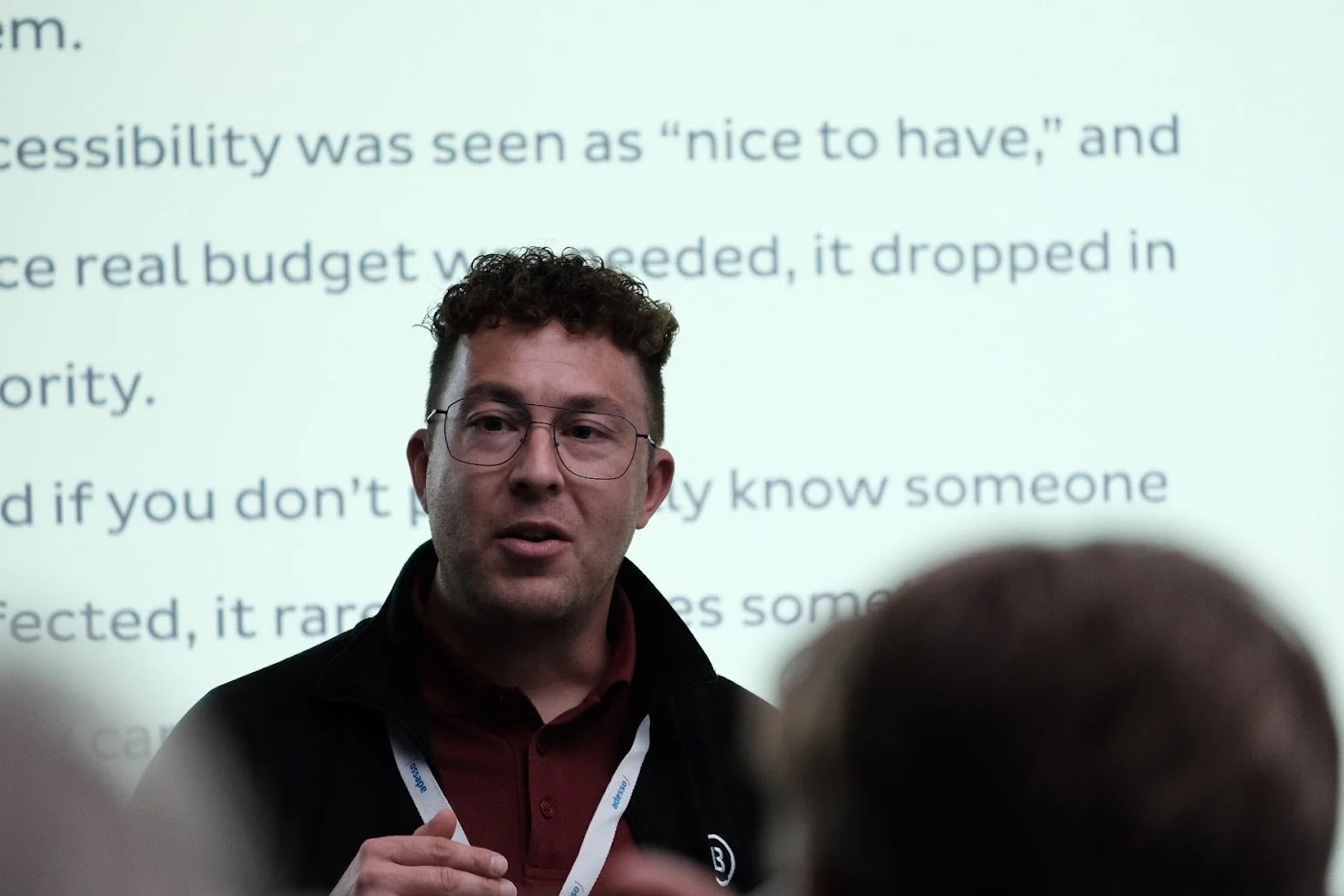
Florian Keitgen from B13 give a brief update on accessibility at the Hamburg 2025 Collab session
He shared stories of organisations that in the past treated accessibility as a last-minute add-on instead of a fundamental design principle. He also walked through examples from their audits: inconsistent tagging, inaccessible colour contrast, missing alt texts, and modules that behaved unpredictably with assistive technologies. Automation, he noted, can help but is never the full solution. Manual testing and real user insight remain central, and tools often introduce new problems when used without expertise.
Florian also reminded us all that accessibility is not purely technical. It requires better conceptual thinking, clearer structures, and more empathy. Improvements made for accessibility often make the experience better for everyone — faster navigation, clearer content, fewer cognitive hurdles.
To quote Florian:
“Accessibility succeeds not through tools but through consistent habits, expertise and intentional design.”
For further details, download his slides (PDF)
Values travel differently
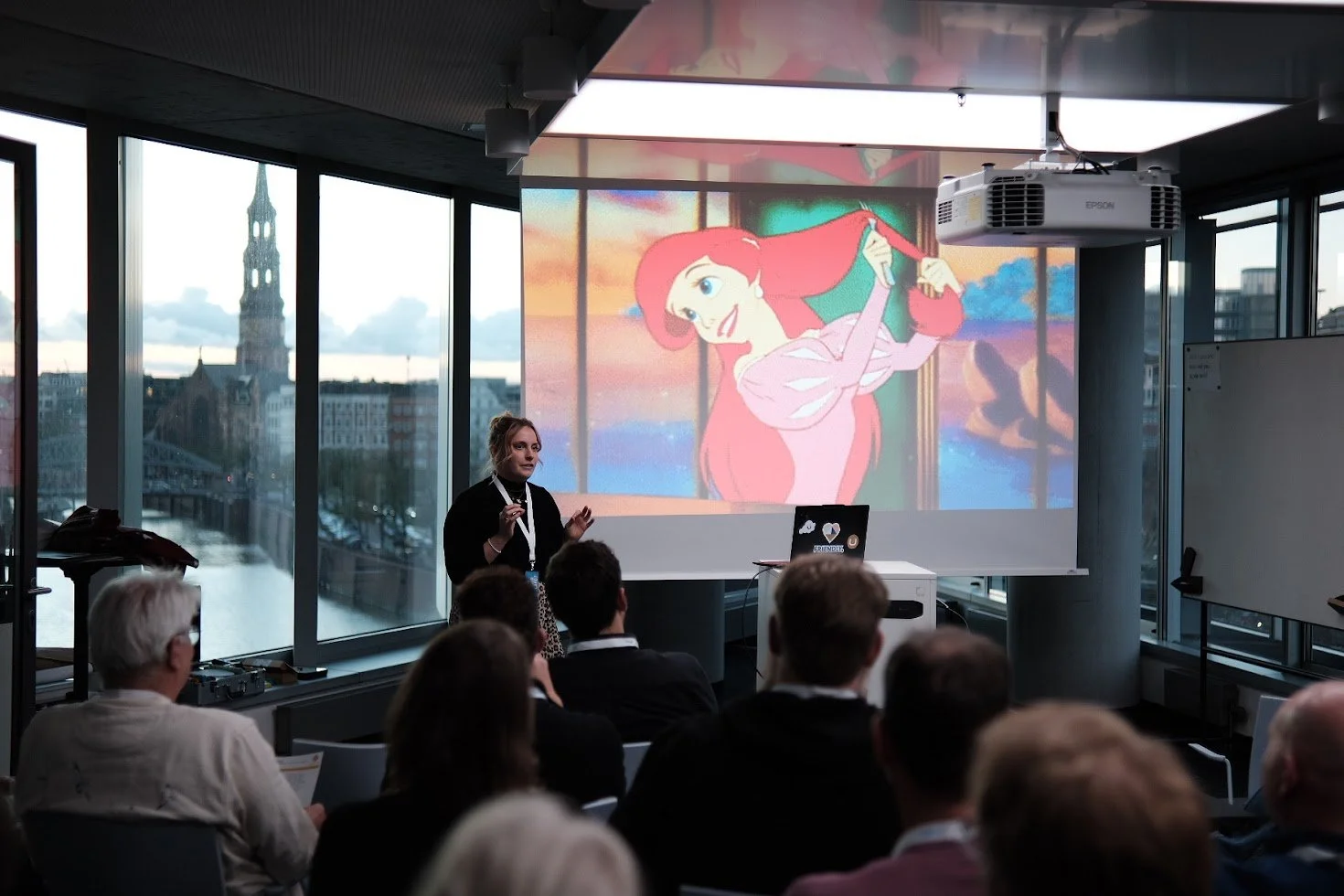
Next up was Rieke Strehle, Partner Manager DACH at Danish CMS vendor Umbraco. She opened with a small story that landed big: in The Little Mermaid, Ariel finds a fork and proudly uses it as a hairbrush, the exact same object, understood differently because of context. That, Rieke said, is how her first eight months in DACH partner management have felt: same values, same brand, same mission, but a different market logic, expectations and nuances.
Her presentation was a personal reflection on her first eight months in the role, centred on Umbraco’s five core values: trust, respect, openness, hunger and friendliness.
These values are a strong part of Umbraco’s identity in Denmark, where they are expressed in warm, informal and highly collaborative ways.
The slide she shared illustrated this clearly, showing the Danish interpretation on one side and the DACH interpretation on the other. For example, trust in Denmark is expressed as believing in people, while trust in DACH is earned through reliability. Respect in Denmark is about every voice mattering, whereas in DACH it is earned through professionalism. Even hunger, which in Denmark is about curiosity and speed, shifts to stability before growth in DACH.
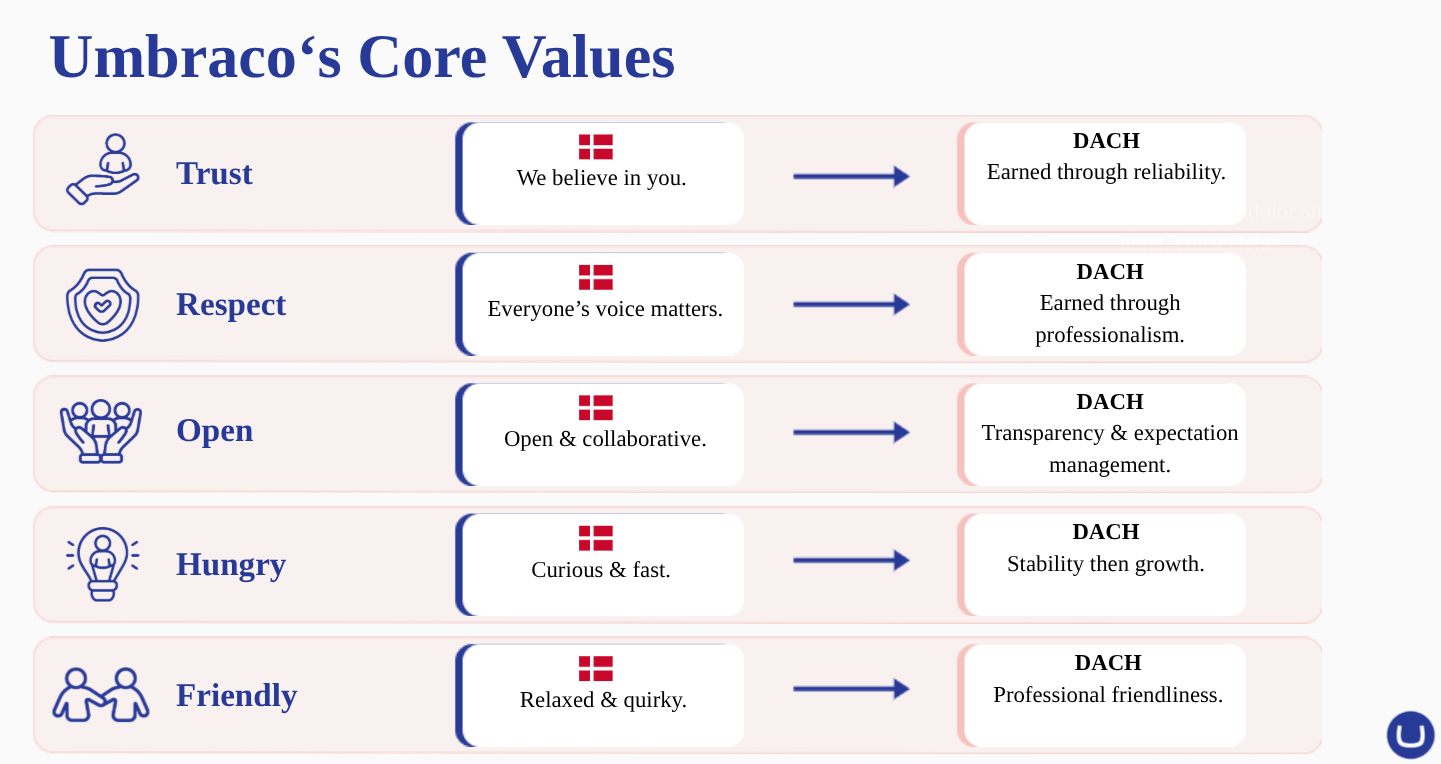
Rieke explained that the values themselves do not change, but how they are perceived, enacted and experienced can differ considerably across cultures. A behaviour that signals friendliness in Denmark can feel overly casual in Germany. A gesture meant to show openness in Copenhagen can come across as vague in Zurich. What makes perfect sense in one context may misfire in another. She summarised this neatly by saying that values travel, and the journey changes them.
Partner management, as she framed it, is the work of understanding these nuances and helping teams translate values so they feel authentic everywhere. To quote:
“You are more than a partner manager. You are a value translator”
She shared examples of how cultural cues can easily be misread. Direct communication may be welcomed as clarity in Denmark but interpreted as criticism in DACH. Enthusiasm may be read as energy in one place and as a lack of seriousness in another. And openness, which Danes often use as a sign of trust, can be misunderstood as indecision when seen through a more structured, expectation-driven lens.
Her message was not that one expression is better than another. It was that carrying values across borders requires humility, patience and curiosity. Values live in behaviours, not slide decks, and leaders play a central role in interpreting them in ways that fit local expectations without losing their essence. For a company like Umbraco, which relies heavily on partner relationships, this cultural translation is not a side task but a core capability.
Rieke closed by reminding us that values do not scale automatically. They scale through people who understand how to express them in ways that others can genuinely receive.
Key takeaway: Values are universal in principle but local in practice, and translating them well requires ongoing attention, cultural awareness and real listening.
For more, you can download the slides (PPT)
Shaping a better experience for online services in Hamburg
Joining us from the City of Hamburg was Svenja Wiegemann, who works as a Digitalisation Expert with a focus on service design and UX. Her role sits at the heart of a major transformation effort: improving the experience of online public services for a city of nearly two million people. She began by acknowledging an uncomfortable truth that many of us recognise from our own interactions with government websites. Many online services simply do not feel good. Citizens struggle with unclear guidance, opaque processes, language barriers and a lack of trust. Even understanding whether you are using the right service at all can be surprisingly difficult.
Svenja explained that this is not due to a lack of effort but to decades of fragmented development across multiple authorities and systems. Modernising these services is inherently complex. Every improvement touches policy, technology, legal requirements and the day-to-day routines of case workers. Even small fixes require alignment across teams that historically worked in silos.
Her talk offered reasons for optimism. She described how user research, journey mapping, iterative design and shared UX standards are increasingly shaping how Hamburg builds services. She highlighted the emergence of unified patterns, a consistent digital brand and growing alignment around standards such as the German Servicestandard, the DIN SPEC 66336 and the KERN UX-Standard. These frameworks promote clarity, consistency and accessibility across federal, state and municipal services. They also echo Hamburg’s own digital strategy, which states that digital services must put people first.

Svenja Wiegemann from the City of Hamburg sharing her key message on stage
A turning point in her presentation was the point that service design now has a seat at the table. Svenja stressed that this shift is significant, yet having a seat is not the same as having influence. In practice, it still requires choosing the right battles, finding the right balance and fighting for the small details that reduce frustration for citizens. These micro-decisions are where service design makes a measurable difference.
She closed with a simple, resonant line that captured the ethos of her work:
Users feel when you put love into the details.
For public services, which often operate under constraints and scrutiny, this sentiment carries extra weight. It is in the thoughtful details that trust is built, friction is reduced and the citizen experience becomes more humane.
Key takeaway: Service design is now firmly part of the conversation in public administration and its impact emerges through persistent, thoughtful improvements that make digital services clearer, kinder and easier for everyone.
How open source is modernising public administration in Schleswig-Holstein
Open source is playing a growing role in how public institutions think about digital infrastructure, and Schleswig-Holstein is one of the clearest examples of this shift. The state is pursuing a long-term approach built on transparency, independence and shared value creation. Rather than relying on proprietary systems that limit flexibility, the goal is to build digital services that can evolve, be audited openly and be shaped by the needs of citizens rather than the constraints of vendors.
Much of this work runs through Dataport, the central IT service provider for several northern German states. Dataport supports everything from administrative systems to citizen-facing platforms and plays a strategic role in ensuring that public digital services remain secure, stable and future proof. It is an organisation where decisions about technology have significant, long-term impact across multiple governments.
With over 15 years of TYPO3 experience, ranging from advertising agencies to Dataport, Anja Scharfenberg is closely involved in this transformation and she joined us for a brief update on the big benefits of open source. Anja leads the Web Portals – Concept and Consulting team and is responsible for CMS Cloud SH, a cloud-native platform for state institutions. Alongside her operational role, she is active in the TYPO3 community and brings experience from both agency and public-sector contexts. Her motivation is straightforward: sharing knowledge, strengthening open source and helping shape the administration of tomorrow.
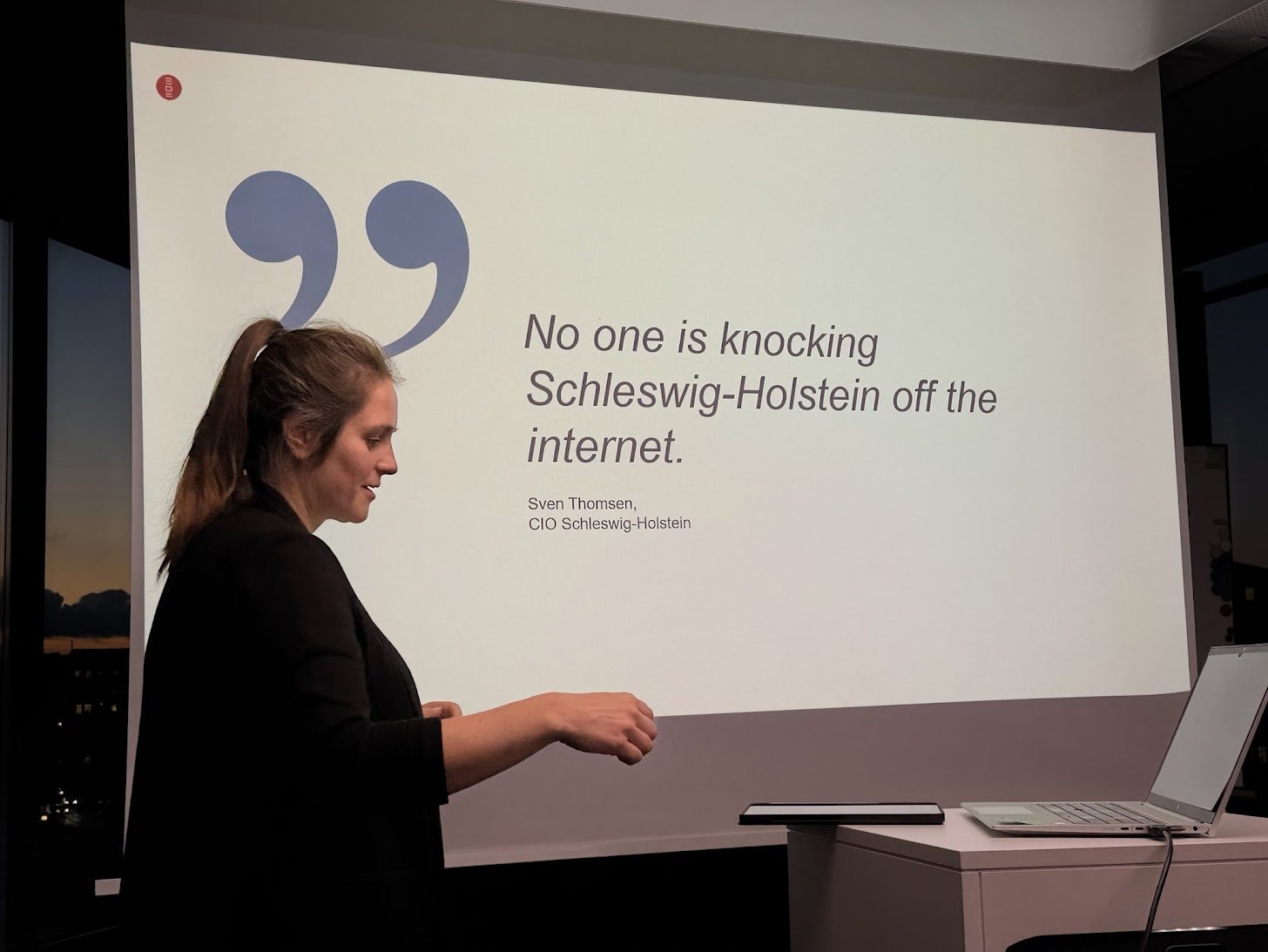
A moment that stayed with many in the room came when she showed a slide featuring a quote from Sven Thomsen, CIO of Schleswig-Holstein:
No one is knocking Schleswig-Holstein off the internet.
It summed up the state’s ambition with quiet confidence. Digital sovereignty is not a slogan. It is a requirement for public services that must function reliably, transparently and under scrutiny.
Anja outlined why open source aligns well with these priorities. Public money can fund solutions that remain publicly reusable. Transparent codebases support security and trust. Interoperability allows organisations to modernise without tearing systems apart. She also emphasised that open source encourages knowledge to remain in-house rather than being outsourced to proprietary vendors.
She described what it means to be an open-source customer. Buying a proprietary product is like buying something fully finished. Choosing open source is closer to tending a shared garden. You work with what exists, benefit from others’ contributions and also take responsibility for contributing back. The health of the ecosystem depends on participation, not passive consumption.
Schleswig-Holstein’s decision to adopt TYPO3 as their CMS reflects that philosophy. TYPO3’s governance model, stability and community-driven development fit well with public-sector needs for longevity and transparency. Contributing to TYPO3 strengthens not only the state’s own digital services but also the wider ecosystem that supports them.
The journey is not without obstacles. Procurement structures still favour closed products. Cultural change takes time. Teams must learn new ways of working and new expectations. But the direction is clear, and the long-term benefits are significant.
Key takeaway: Open source offers public institutions a practical path to digital independence and resilience, provided they remain active stewards of the ecosystems they rely on.
The new kind of content: designed for humans and agents
AI is rapidly becoming an intermediary inside organisations, not just a tool at the edges. Kevin Hähnlein, Principal in Strategic Advisory at Staffbase, explored what this means for internal communication and intranets. His central point was simple: most intranet content in the near future will be read by AI agents before it is ever read by employees. AI becomes the gateway, the first point of contact, the filter and the explainer. This shift changes how content needs to be written, structured and governed.
Kevin illustrated how employees increasingly rely on conversational interfaces to find information. When someone asks a chatbot about holiday rules, policies, benefits or onboarding, the quality of the answer depends entirely on how the underlying content has been prepared. The slide titled AI becomes a gatekeeper captured this well. Content now needs to serve two audiences. Humans require clarity, context and narrative. Agents require structure, metadata and consistency.
A striking insight came from one of the data points he shared. The average frontline employee spends just 90 seconds per month with internal company news. It is an extraordinarily small window of attention and underscores how unrealistic it is to expect people to navigate long intranet structures or manually search for updates. The burden is shifting from the employee to the system. In a world with so little time, content must be surfaced for them, not hidden inside deep hierarchies.
Another challenge is that employees cannot ask for what they do not know exists. Kevin used the iceberg metaphor to explain this. Known unknowns are the things people actively search for, such as payslips or time off. Unknown unknowns sit below the surface. These are often the most important topics, including compliance changes, security requirements, workplace updates or learning opportunities. Without structured content, AI cannot surface these proactively, and employees remain unaware of information they genuinely need.
This led into Kevin’s five principles for agent-ready intranet content. Start with facts-first headers so AI understands authority and scope. Write with dual layer design, separating what someone needs to know from why it matters. Use canonical templates for different content types so the structure becomes predictable. Apply metadata and lifecycle governance so pages do not decay over time. And finally, bridge human trust and machine trust by combining clear provenance with a meaningful, authentic tone.
He also noted how content creation itself is changing. Prompt-based authoring, supported by AI trained on best practices, is already reshaping how drafts are produced and refined. The discipline of content strategy becomes less about writing individual pieces and more about designing systems of clarity, ownership and consistent structure.
Kevin closed by reminding us that intranets are becoming knowledge APIs. They feed both people and machines. The organisations that prepare for this now will deliver clearer answers, better employee experiences and more reliable automation in the years ahead.
Key takeaway: AI will read intranet content before humans do, and employees engage for only seconds each month, so content must be structured, governed and ready to serve both audiences effectively.
You can also view his slides from the session and for background, see also this blog post from 2023 with Kevin: How AI will transform internal communications.
A more trustworthy and agile alternative to moving fast and breaking things
The challenge many teams face is how to stay genuinely agile once regulation enters the picture. Processes tighten, documentation expands and audits appear to stand in direct opposition to lean, iterative development. This tension formed the starting point of the talk by Tobi Stadelmaier, Head of Engineering at TCC Clinical Solutions. With more than twenty years in enterprise software, he brought the perspective of someone who has worked on both sides of the divide: first in unregulated B2B environments and now in the highly regulated world of telemedicine, where software must comply with standards such as ISO 13485 and IEC 62304.
Tobi speaks with a practical understanding of what this shift involves. At TCC he leads engineering for clinical software used in sensitive medical contexts, where every decision must be traceable and every change must be justified. Yet in his view this does not make agility impossible. Instead, he argued that modern engineering practices are in many ways better suited to regulatory compliance than traditional methods. Much of the friction comes not from the standards themselves but from how they are interpreted.
He organised his talk around two recurring problems: the myth and the theatre.
The first is the committee review myth. Many teams believe that compliance requires heavy, slow, multi-person review committees, complete with scheduled meetings and printed sign-offs. Tobi contrasted this with what standards actually require: independence in review, documentation of discussion and a persistent record of decisions. A standard pull request workflow, with proper reviews and recorded comments, satisfies all of this. In fact, he argued that PR-based review is often more rigorous, more transparent and better evidenced than any committee could be.
The second challenge is the traceability theatre. Here Tobi described how organisations often overcomplicate traceability by creating sprawling Excel sheets or intricate manual processes that satisfy neither engineers nor auditors. Standards require traceability, but they do not mandate how it should be achieved. Automated traceability, grounded in modern tooling, connects epics, user stories, commits, tests and results in a way that is both trustworthy and efficient. Good tools provide better evidence than manual processes and reduce the temptation to perform traceability as theatre rather than as a meaningful practice.
From there he moved into a set of principles that apply across industries. Automation can act as evidence. Real-time checks outperform periodic audits. Tooling can serve as a control system when used effectively. And scrutiny should be proportional to risk instead of uniformly heavy. These patterns allow teams to move quickly where appropriate and carefully where needed, without sacrificing safety or quality.
Tobi closed with a recommendation that captured the spirit of his talk. He pointed to the memorable book “F*ck it, Watch This” with the subtitle Saying the Quiet Parts Out Loud by Ana Visneski as a guide on how to challenge restrictive interpretations of rules without breaking them. It is, in his words, a reminder that successful compliance is not about performing ritual but about meeting real quality objectives with the tools and practices of today.
You can meet Tobi in our product management community and also download the slides.
The journey to a dotBrand
This unplanned impromptu session was led by Martin Kuechenthal, CEO of LEMARIT, who introduced the room to a topic that few had heard of and even fewer had explored in depth: the dotBrand.
With more than twenty years of experience in digital brand protection and domain strategy, Martin explained that a dotBrand is a top-level domain operated exclusively by one organisation, for example .brand. Owning such a domain means owning a small but significant piece of the internet’s infrastructure rather than renting space within it.
He described why companies pursue a dotBrand. From a brand perspective, it offers clarity, trust and creative freedom. Addresses become simpler and more meaningful, whether for campaigns, regional sites or internal tools. From a security perspective, the benefits are even clearer. A dotBrand reduces attack surfaces by limiting registrations to a single controlled environment. It strengthens authentication, reduces phishing risks and ensures that every domain under the extension is trustworthy by default.
Martin illustrated how organisations are already using dotBrands today, across corporate websites, knowledge bases, retail networks and customer portals. Once companies operate within their own namespace, they tend to discover new patterns that are simply not possible with legacy domain portfolios. The result is a more coherent digital identity and a more manageable infrastructure.
He also highlighted the practicalities. ICANN will open the next application window in April 2026. It is not yet known when or whether another opportunity will follow. For organisations that want their own extension, preparation must begin well in advance. It requires coordinated work between legal, IT security, marketing and leadership, as well as a clear understanding of the business case. Costs are significant but predictable, and for large organisations they often replace fragmented domain spending with something more strategic.
Martin closed with a simple message. The journey to a dotBrand is not a technical project but a strategic decision about trust, identity and long-term control. The organisations that begin their planning now will be ready when the window opens.
For more details, Martin has shared a brief presentation (PDF).
On high-performance coaching
An emotional video opened the next session, and within seconds the room shifted. This was not going to be a talk about AI, KPIs or coaching drills. It was about why people strive at all and what gets us up in the morning. For Aditya Pasarakonda, sport is a lens through which you see motivation, belonging and possibility. The video made that point before he even spoke.
Lean back and enjoy the video below.
Adi is a high-performance hockey coach at Der Club an der Alster, one of Germany’s most respected clubs, and he has coached across Swiss, Indian, German and US field hockey systems. His background reflects multiple worlds. He grew up in Switzerland in an Indian family and let’s saystrong personal values around hard work, resilience and responsibility surrounded by different looking kids. From his childhood, he learned early on to navigate different cultures and expectations. Now in Hamburg, these experiences inform his approach to coaching, where emotional intelligence and discipline go hand in hand.
He built a bridge between amateur sport and organisational life that felt immediately relevant. Hockey is an unpaid amateur sport. Players train and compete alongside full-time jobs or studies. They do it not for financial reward but for meaning, pride and the feeling of belonging to something bigger than themselves. In many workplaces, teams face a similar reality. You cannot rely on hierarchy or compensation alone to secure commitment. Instead, you rely on purpose, clarity and the behaviours that make collaboration possible.
To illustrate this, Adi introduced Simon Sinek’s Golden Circle. Teams that start with why anchor their behaviour in purpose, which gives them stability under pressure and a shared reference point when things become difficult. The what and the how matter, but without a clear why they rarely inspire commitment. In both sport and work, purpose turns effort into intention.
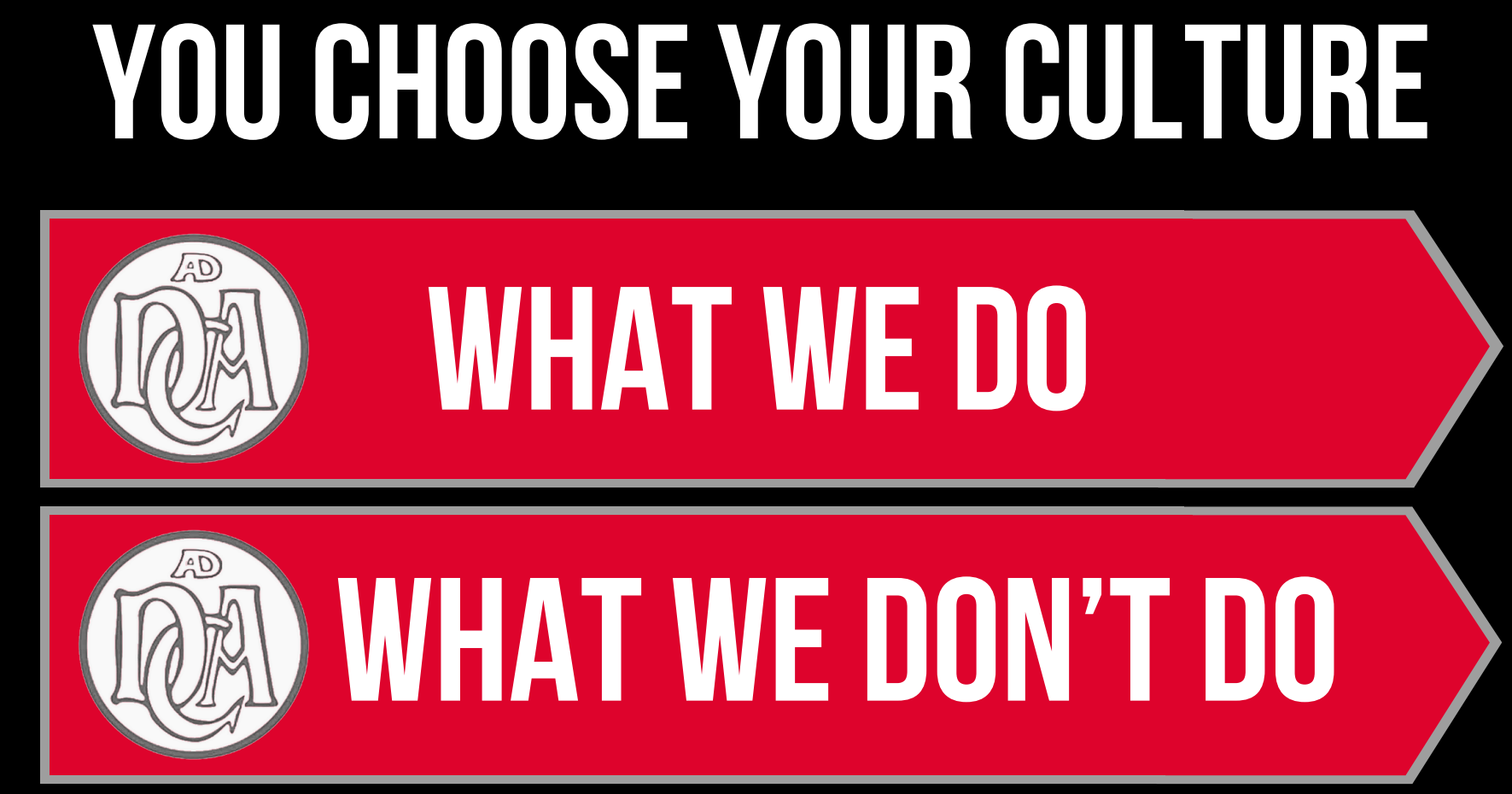
Only after laying this foundation did Adi turn to a message that has shaped much of his career: you choose your culture. Culture is built through the decisions teams make about what they consistently do and what they consciously avoid. He gave us some memorable examples from hockey and framed buy-in through two lenses: energy, which is the intent and discipline you bring, and behaviour, which is how you show that commitment in practice. High-performance teams attend to both with care.
Adi closed with a quote that stayed with many in the room:
We are because you are, and since you are, definitely I am.
It captured the interdependence at the heart of high-performing teams. Belonging is not soft. It is what enables accountability, shared ambition and the willingness to carry each other when needed.
Slides are available at request to those who joined, but what’s even better than looking at slides? Go watch him in action at the next hockey game!
The design of gingerbread things
The final session of the day came from Hertje Brodersen, a Berlin-based design leader who gently took us somewhere both unexpected and deeply familiar: the world of gingerbread. Baking, she noted, is often a family activity. It is collaborative, occasionally chaotic and full of choices that require judgment. Gingerbread is also a seasonal staple, which gave her talk an immediate sense of warmth and relevance. But in Hertje’s hands, it became something more: a thoughtful way of looking at how creative work really gets done.
Hertje’s background spans creative direction, concept development and design across agencies and cultural organisations. She understands the craft behind experiences as much as the strategy, and that mix shaped her approach here. Motivation, she said, is always the starting point. You might bake a simple house. Or you might decide, for reasons known only to you, that what the world really needs is gingerbread inspired by Star Wars. Once you choose a direction, the design process begins. You think about structure, stability, angles, decoration and what level of detail is actually worth the effort.
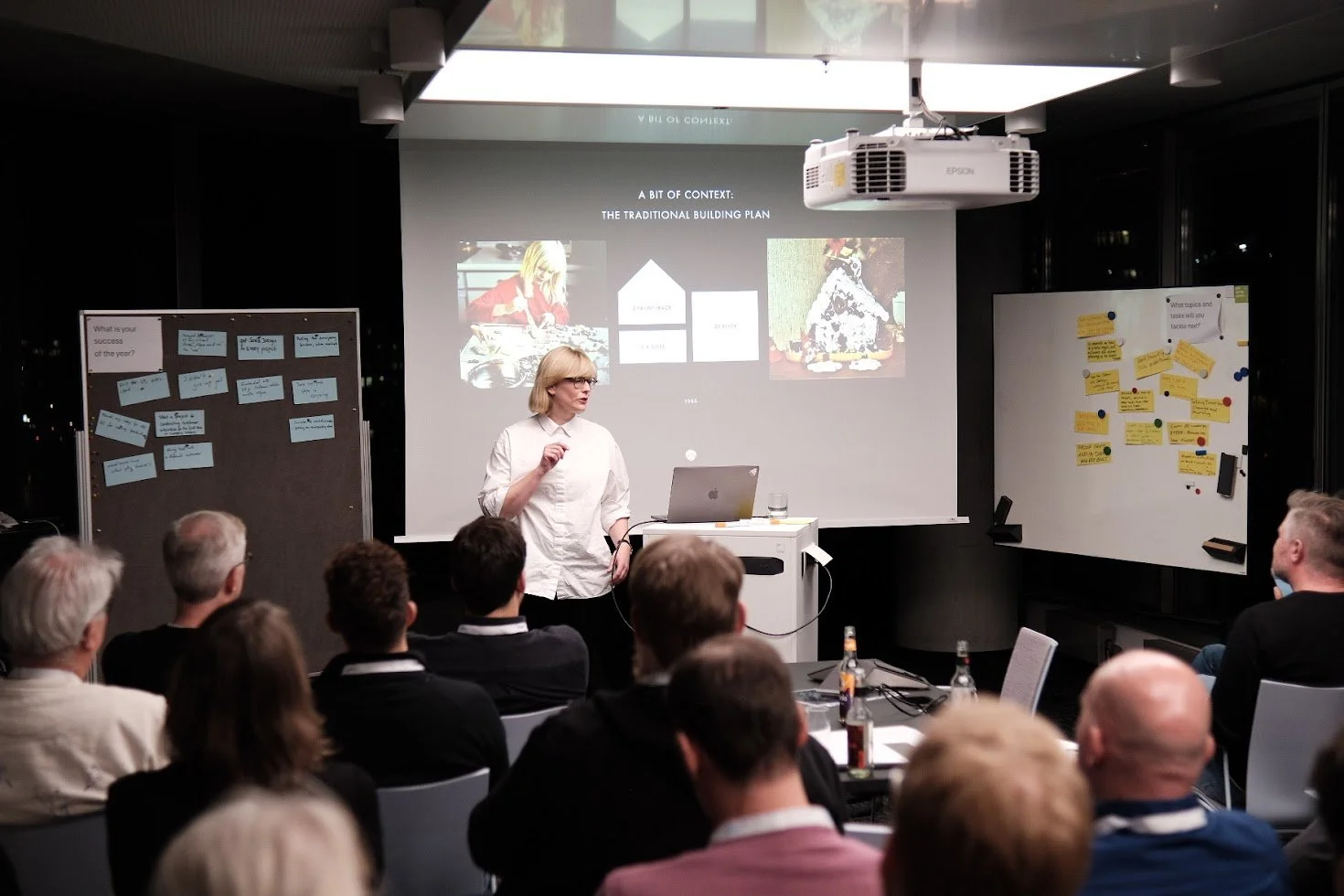
Hertje sharing some context for the design of gingerbread things
From there she drew a parallel to digital work. Gingerbread has constraints. Dough stretches, sags and cracks. Heat distorts shapes. Timing matters. These limits are not obstacles but characteristics of the material. Designers, writers and developers face equivalent constraints in their daily work. Systems, budgets, deadlines and organisational patterns shape what is possible just as surely as the properties of dough do.
Hertje reminded us that good design, whether edible or digital, almost never happens in a straight line. It is iterative. You try something, adjust it, correct it and sometimes abandon it. The value lies not in producing perfection but in learning what the medium allows and how your idea evolves through attempts.
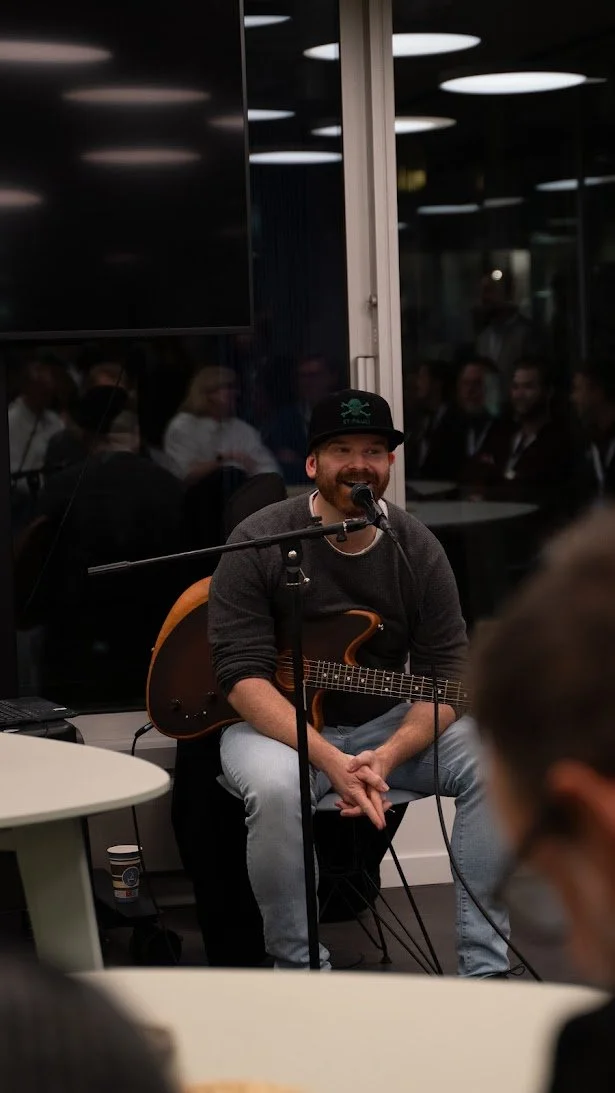
Florian Gentsch-Lanwer joined for some very enjoyable live music after all the presentations
The session closed the afternoon on a grounded and human note. After a full programme of strategy, AI, design, governance and much more, Hertje brought us back to the essence of making things: motivation, material, constraint and the quiet satisfaction of creating with intent. Or in brief: Creativity thrives when we embrace constraints, stay curious and allow room for play.
That’s all we had! Thanks to our host Klaas, for arranging a nice intermezzo with live music in the office, and then to our local member Volker Graumbaum for arranging a charming dinner.
What’s on for 2026
The 2026 calendar is already in motion, with gatherings planned for Düsseldorf and Hamburg early in the year. The conversation naturally continues in our peer groups at conferences in Europe and North America. Why not join us and be a part of it?
If 2025 taught us anything once again, it is that learning happens in community, not isolation — and that the work ahead is made lighter, sharper and more ambitious when we do it together.
This annual Hamburg tradition has been going for a while and you can read the summaries from past years:
What might 2024 bring? (the 2023 end of year meeting)
Save the date for our 2026 end of year meeting on 26 November. Get in touch for an invite.